
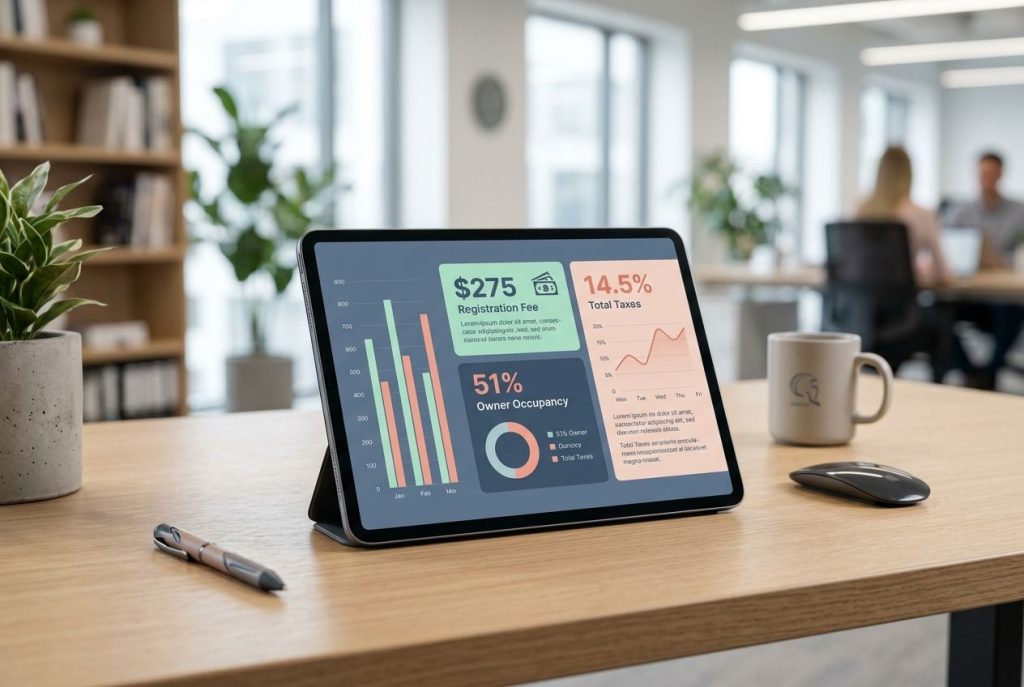
Short-term rentals are legal in Orlando, but you must follow strict rules. The City of Orlando requires a vacation rental license with a $275 registration fee. You must live on-site for 51% of the year. You pay 14.5% in total taxes on each booking.
This guide explains exactly what you need to do. You will learn about permits, licenses, and zoning rules. You will understand occupancy limits and tax obligations. You will discover how to stay compliant and avoid heavy fines.
Here is everything you need to know.
Key Takeaways
- >Short-term rentals in Orlando require a $275 registration fee, owner occupancy of 51% yearly, and compliance with strict zoning and safety regulations.
- >Hosts pay 14.5% total taxes including 6% state sales tax, 6% Tourist Development Tax, 0.5% county surtax, and 2% Convention Development Tax.
- >Orlando enforces quiet hours from 10 PM to 7 AM with fines starting at $250 daily, potentially reaching $5,000 for serious violations.
- >Property owners must obtain multiple permits from the City of Orlando, Florida DBPR, county tax collectors, and pass mandatory safety inspections before operating.
- >Maximum occupancy limits allow two guests per bedroom plus two extra guests, with only one booking permitted simultaneously in residential zones.

What qualifies as a short-term rental in Orlando?
Orlando defines short-term rentals as properties rented for less than 30 consecutive days and rented more than three times per year. These rentals include listings on Airbnb, Vrbo, Booking.com, and direct bookings from guests.
The City of Orlando and the Florida Department of Revenue track these transactions closely. Short-term rentals differ from long-term rentals, which typically run for 30 days or longer and occur fewer than four times annually.
Orlando recognizes several types of short-term rental properties:
- >Home shares occur when the owner or tenant resides on-site for at least 51% of the year
- >Commercial dwelling units operate as entire-home rentals in zones designated for commercial use
- >Bed and breakfasts, group housing facilities, and hotel/motel properties also qualify
The City Planning Division classifies each property type based on its location, zoning status, and operational structure. Your property listing must match one of these categories to obtain proper permits and business licenses from the city.
Understanding your property’s classification helps you navigate permitting requirements and avoid code enforcement issues. According to the 2026 City of Orlando Short-Term Rentals Fact Sheet, converting a garage, carport, or other DIY structure into an extra bedroom without finalizing city inspections will disqualify the property from being legally rented out as a short-term rental.
This prevents property owners from sinking money into unpermitted renovations or adding extra beds to increase booking capacity, only to have their registration instantly rejected by code enforcement division.
Key City of Orlando short-term rental regulations
Orlando’s short-term rental rules shape how you operate your property in the city. You must understand permits, occupancy limits, zoning restrictions, and noise rules to stay compliant.
Orlando property management companies like Guestmanagers.com do more than help you follow short-term rental laws. They make your rental income grow while keeping you safe from code enforcement division penalties.
GuestManagers handles tourism tax licenses, tourist development tax payments, and home sharing registration so you don’t have to worry. Our team knows the rules that apply in Orlando, Kissimmee, and St. Cloud. Smart property management turns your home into a profitable investment that follows every city rule.
What permits and registrations are required for short-term rentals?
You need several permits and registrations to operate a short-term rental legally in Orlando. Each permit serves a specific purpose and protects both your property and your guests.
- 1. City of Orlando Home Share Registration costs $275 for initial registration, then $125 annually. Visit orlando.gov/homeshare to complete your application online.
- 2. Business Tax Receipt from the City of Orlando is essential for local business compliance. You must obtain this before you start renting your property.
- 3. Short-Term Rental License application goes through the City of Orlando Business Tax Office. This license requires periodic renewal to stay current with regulations.
- 4. Florida Department of Business and Professional Regulation (DBPR) license covers all vacation home rentals under 30 days. Apply online at myfloridalicense.com for this state-level permit.
- 5. DBPR licensing costs $170 per year for one unit or $180 for up to 225 units. Your property management company can help you calculate the exact fee.
- 6. County Tax Receipt must come from Orange County, Osceola County, or Polk County, depending on your location. This registration ensures you comply with county-level property management rules.
- 7. Tourism tax license registration may apply to your rental income depending on your county. Contact your local code enforcement division for specific requirements.
- 8. Annual renewal of all permits keeps your home sharing registration active and valid. Mark renewal dates on your calendar to avoid compliance issues.
Professional property management companies like Guestmanagers.com simplify the permit process considerably. These experts ensure your rental income stays protected while you maintain full compliance with tourist development tax obligations and local regulations.
What is the owner-occupied rule for short-term rentals?
Orlando’s owner-occupied rule creates a clear framework for homeowners who want to rent out part of their property. The City of Orlando requires that owners live on-site for at least 51% of the year to qualify as a home sharing rental.
This means you must spend more than half your days in the property you rent out. Owners can rent up to half of the total bedrooms for stays between 1 and 29 days under Chapter 58 Part 5B(19) regulations.
The host must be present during the guests’ stay. The property cannot exceed half of the total dwelling unit available for rental. Registration with the city and an annual fee are necessary steps to operate legally under these guidelines.
The Florida Department of Business and Professional Regulation oversees these classifications to maintain neighborhood stability across the state. Under the City of Orlando’s Home Sharing Registration guidelines, placing deadbolt locks on individual bedroom doors or providing separate mini-refrigerators and microwaves in guest rooms will classify a property as a prohibited “group home” rather than a legal home share.
This helps hosts avoid accidental code violations when they attempt to make their rented bedrooms more private or convenient for guests. It ensures they stay within the legal home-sharing framework.

Compliance with Orlando’s owner-occupied rules protects your investment and keeps your rental business operating smoothly.
Group housing permits offer a different path for owners who want longer rental periods. Properties with kitchens can qualify for group housing permits if they rent for 7 days or more, such as dormitories and boarding houses without direct care or supervision.
Owners must obtain a Zoning Official Letter of Determination and a Business Tax Receipt to move forward with this option. These regulations ensure that owner-occupied facilities remain primarily residential while allowing property owners to generate income from their homes.
Professional property management companies like Guestmanagers.com help owners navigate these owner-occupied requirements while maximizing rental income. These services ensure your property meets all City of Orlando standards, handles registration paperwork, and maintains compliance with local zoning laws.
What are the occupancy and space limits for rentals?
The City of Orlando sets strict occupancy rules that hosts must follow. Your rental can hold a maximum of two guests per bedroom, plus two extra guests, for a total of four people per booking.
This limit applies to entire living spaces rented for short periods. Home sharing rentals, where you rent out part of your property, face tighter rules. You can rent only half of your bedrooms to guests.
The city enforces these occupancy limits during safety inspections. Property management companies verify compliance before guests arrive. Bed and breakfast operations follow different rules. They can serve up to two rooms in residential districts for stays ranging from one day to seasonal periods.
| Rental Type | Maximum Occupancy | Bedroom Limit |
|---|---|---|
| Entire Home | 2 guests per bedroom + 2 extra | All bedrooms |
| Home Share | 2 guests per bedroom + 2 extra | Half of total bedrooms |
| Bed & Breakfast | Varies by permit | Up to 2 rooms in residential |
Only one booking is allowed at a time under City of Orlando rules. This means you cannot have multiple groups staying in your rental simultaneously. This single-booking requirement protects neighborhoods from excessive noise and traffic.
The Florida Department of Business and Professional Regulation works with local authorities to ensure hosts meet these space standards. Your rental must adhere to maximum occupancy regulations set by the city. Violations can result in fines or loss of your short-term rental permit.
City inspections reveal compliance gaps that many hosts overlook. In a recent inspection sweep of 36 home sharing listings across Orlando residential zones, inspectors discovered that 22 properties listed more bedrooms for booking than the “two guests per bedroom plus two” rule permits.
Nine owner-occupied listings exceeded the half-bedroom rental limit despite qualifying as home shares. During this compliance effort, over half the inspected listings exceeded the posted occupancy rules or misclassified tenant rooms. These findings highlight why the City of Orlando conducts thorough inspections and enforces strict occupancy limits to protect neighborhood integrity and guest safety.
Professional property management services help hosts understand these limits and maintain compliance throughout the year. Orlando property management companies like Guestmanagers.com play a vital role in helping hosts succeed. Our team ensure your rental follows all occupancy and space laws while maximizing your rental income.
Which zoning and location restrictions apply to short-term rentals?
Zoning rules shape where property owners can operate short-term rentals in Orlando. The city restricts entire-home rentals in most residential zones unless the property sits in commercial or mixed-use districts.
Property owners must check their specific zoning classification at orlando.gov/zoning to understand what their location allows. Overlay districts, such as the Downtown Orlando Overlay District, enforce stricter rules that property owners must follow.
Some neighborhoods have restrictions that go beyond standard zoning codes. Owners need to verify their exact zoning category because not all zones permit all rental types. This step prevents costly mistakes and legal troubles down the road.
Location matters significantly for short-term rental success in the Orlando area. Properties within city limits follow Orlando city council regulations, while unincorporated Orange County properties operate under different, less restrictive rules for entire-home rentals.
Property owners can verify their exact location through www.ocpafl.org. Properties marked as “Unincorporated” must contact Orange County Government to learn local short-term rental laws. According to Orange County‘s 2026 Zoning Division rules, short-term rentals of less than 30 days are strictly prohibited in residential zones unless the owner applies for and secures a discretionary Special Use Permit.
Investors often confuse an “Orlando mailing address” with City of Orlando jurisdiction. Knowing that unincorporated Orange County requires a special permit prevents investors from buying a property they legally cannot operate as a whole-home rental.
HOA properties require written permission from the homeowners association before launching any rental operation. Zoning verification through orlando.gov/zoning confirms allowable uses for each specific property. Outside city limits, zoning and HOA rules still apply even though entire-home rental restrictions ease considerably.
Understanding these location-based rules ensures compliance and protects property investments from violations. Orlando property management companies like Guestmanagers.com provide essential support for rental hosts managing these zoning and location rules. We ensure your property meets all city requirements while maximizing rental income.
What are the quiet hours and noise rules for rentals?
Orlando enforces strict quiet hours from 10 PM to 7 AM every single day. Under the County of Orange Noise Control Ordinance (Section 4-6-5), continuous exterior noise cannot exceed 50 decibels during the 10 PM to 7 AM quiet hours, and is capped at a maximum of 55 decibels during daytime hours.
Giving hosts the exact legal decibel limits helps them choose the right noise-monitoring equipment (like Minut or NoiseAware). It allows them to set clear, measurable expectations in their listing’s house rules.
Your guests must keep noise levels low during these times. Loud music, parties, and excessive sounds violate city regulations. You must inform guests of these quiet hour restrictions before they arrive.
Failing to follow noise rules can result in fines of $250 per day. Serious violations may increase fines up to $5,000. The city takes noise enforcement very seriously.
Your rental permit can face revocation if violations happen repeatedly or become serious. Neighbors often report noise disturbances, so maintaining good relations with them matters greatly. Enforcement actions can lead to legal trouble and loss of your rental privileges entirely.
Property management companies help you stay compliant with all noise regulations. These professionals ensure your guests understand quiet hour rules before check-in. They handle neighbor complaints quickly and professionally.
Expert managers protect your rental business by preventing violations before they start. Companies like Guestmanagers.com make your rental profitable while keeping you safe from legal issues. We know Orlando short-term rental laws inside and out.
What tax obligations do short-term rental hosts have?
Short-term rental hosts in Orlando must pay Florida sales tax and the Tourist Development Tax on their rental income. The Florida Department of Revenue requires you to register, collect taxes, and file returns on time to stay compliant with state law.
How does the Florida State Sales Tax apply to rentals?
Florida’s state sales tax applies to all short-term rentals that last under 30 days. The state tax rate stands at 6%, and you must collect this tax on your rental income.
This tax covers more than just your nightly rate. It includes cleaning fees, service charges, and any other fees guests pay. For example, a three-night stay at $130 per night with a $45 cleaning fee totals $435. You calculate the state tax at 6% on this full amount, which equals $26.10.
Hosts must register with the Florida Department of Revenue to obtain a Florida Sales Tax Number. This registration ensures you comply with state requirements and can properly report your tax obligations.
Platforms like Airbnb and Vrbo may collect state tax for hosts, depending on local agreements in your area. However, you remain responsible for ensuring all applicable state taxes get remitted to the Florida Department of Revenue, even if the platform collects the money.
This means you should verify whether your platform handles tax collection or if you need to pay it yourself. Owners of short-term rental properties in Orlando, St. Cloud, and throughout Florida must understand this obligation.
What is the Tourist Development Tax and who pays it?
The Tourist Development Tax, also called the Transient Rental Tax, applies to all short-term rental bookings in Florida. This tax funds tourism promotion and infrastructure projects in each county.
In Orange County, hosts collect and remit a 6% tax on every booking. Osceola County charges 6% plus an extra 1.5% discretionary surtax, bringing the total to 13.5%. Polk County sets its rate at 5%.
The Florida Dept. of Revenue oversees these tax rules across the state. Hosts must register with their county tax collector to stay compliant. For example, a $435 booking in Orlando generates $26.10 in Tourist Development Tax that the host owes to Orange County.

| County | Tourist Development Tax Rate | Additional Surtax |
|---|---|---|
| Orange County | 6% | 0.5% county + 2% convention |
| Osceola County | 6% | 1.5% discretionary |
| Polk County | 5% | 1% discretionary |
Platforms like Airbnb sometimes collect and submit this tax directly, but hosts remain responsible if the platform does not. The host pays the tax unless the rental platform handles it on their behalf.
Each county tax collector maintains records of registered short-term rental operators. Hosts who fail to register or remit taxes face penalties from the Florida Dept. of Business and Professional Regulation. Property management companies help hosts track these obligations and ensure timely payment.
Are there county-level taxes for short-term rentals?
County taxes stack on top of state sales taxes for your short-term rental income. Orange County charges a local surtax of 0.5% on every booking. The Convention Development Tax adds another 2% specifically for Orlando properties.
This means your total tax burden reaches 14.5% when you combine state and county taxes together. Polk County operates differently. Hosts there pay a total vacation rental tax of 12%, which includes the discretionary sales surtax of 1%.
Osceola County maintains its own rate at 13.5% for all vacation home transactions. Your county location determines which taxes apply to your business, so you must identify your property’s exact jurisdiction before launching your rental.
A concrete example clarifies how these taxes affect your bottom line. Consider a typical three-night Orlando booking priced at $130 per night with a $45 cleaning fee, totaling $435.
- >State sales tax at 6% adds $26.10
- >The Tourist Development Tax at 6% contributes another $26.10
- >The county surtax of 0.5% adds $2.18
- >The Convention Development Tax at 2% brings $8.70
Combined, these taxes total $63.08, representing the full 14.5% burden. A $435 Orlando booking can carry about $63 in combined state and local taxes, reducing net revenue unless managed correctly. Understanding this breakdown helps you price competitively while maintaining profitability after all tax obligations are met.
Platform companies handle some tax collection automatically, but you bear responsibility for taxes they don’t collect. Your booking platform may remit the state sales tax but skip the local surtax or convention tax. You must file these taxes manually if your platform fails to collect them.
A realtor or property management service like Guestmanagers.com can clarify which taxes your platform handles and which ones you must pay separately. Understanding your county’s specific tax structure prevents costly mistakes and keeps your short-term rental operation profitable and compliant with local requirements.
How to obtain licensing and ensure compliance
You must secure state permits, local licenses, and zoning approvals to run a legal short-term rental in Orlando. Read on to learn exactly what steps you need to take.
How do I obtain state and local permits?
Obtaining permits for short-term rentals requires you to work with multiple government agencies across different levels. Each county and the state itself has specific requirements that you must complete before you can legally operate your rental property.
The multi-agency permit process follows a predictable timeline when properly executed. Start by submitting your City Home Share application along with the $275 fee on Day 0. Within 7 days, you typically receive preliminary zoning confirmation from the city.
By Day 14, complete your DBPR online application and pay the $170 state fee. Around Day 21, schedule your required safety inspection with city inspectors. If your property passes without deficiencies, you receive your city registration number by Day 28.
Expect roughly four weeks from first application to a cleared registration when documents are correct and inspections pass on the first visit. This timeline assumes no corrections are needed, so prepare all documents thoroughly before starting.
- 1. Visit orlando.gov/homeshare to register your short-term rental with the City of Orlando and obtain your required permit.
- 2. Apply for an Orange County short-term rental permit through orangecountyfl.net if your property sits in Orange County.
- 3. Contact the Osceola County Community Development Department to obtain your short-term rental license. Expect an initial inspection fee of $160 and a license fee of $250 valid for one year.
- 4. Pay the Osceola County renewal fee of $150 each year to keep your license active and in good standing.
- 5. Obtain a Class B County Local Business Tax Receipt from Polk County if your rental operates for less than six months per year.
- 6. Submit your Polk County application with the $50 application fee plus the $10 Hospitality Education Program fee to get started.
- 7. Complete your Polk County license fee payment, which varies based on your rental property size and capacity.
- 8. Mark your calendar for September 30 each year. Polk County requires you to renew your license by this deadline.
- 9. Apply for your Department of Business and Professional Regulation license online at myfloridalicense.com to meet state requirements.
Professional property management companies like Guestmanagers.com help you navigate these permit requirements efficiently. These experts ensure your rental stays compliant with all local and state regulations while maximizing your rental income.
How can I confirm zoning and HOA approval?
Confirming zoning and HOA approval protects your rental investment and keeps you legal. You must verify these details before launching your short-term rental business.
- 1. Visit orlando.gov/zoning to check your property’s zoning classification and confirm it allows short-term rentals in your area.
- 2. Use www.ocpafl.org to locate your property and verify if it sits in an unincorporated zone. Unincorporated properties require contact with Orange County Government for local rental laws.
- 3. Contact your local HOA directly and request written permission for short-term rental operations. Many associations prohibit this activity entirely.
- 4. Confirm that Orange County allows short-term rentals in residential and commercial zones, but note that accessory dwelling units face restrictions.
- 5. Verify Osceola County properties exist only in designated tourist zones. Standard residential areas prohibit short-term rentals completely.
- 6. Check Polk County zoning laws that apply to your specific property location and usage type.
- 7. Reach out to FunStay Homes for professional zoning verification services that confirm your property sits in legal short-term rental zones.
- 8. Review your property deed and HOA documents for any clauses that restrict rental activities or require special approvals.
- 9. Confirm that not all zoning categories permit all rental types. Hosts should verify allowable uses match their business plans.
Property management companies like Guestmanagers.com help owners navigate zoning rules and HOA requirements while maximizing rental profits. We ensure your rental complies with local laws and operates smoothly for long-term success.
What safety inspections are required?
Safety inspections protect your guests and keep your rental compliant with local rules. Orlando and Osceola County mandate specific safety equipment and inspections before you can operate your short-term rental legally.
- 1. Install smoke detectors throughout your property to meet city and county safety standards. These devices must work properly during inspections.
- 2. Place carbon monoxide alarms in bedrooms and common areas where guests sleep. This equipment saves lives and satisfies inspection requirements.
- 3. Mount fire extinguishers in your kitchen and other high-risk zones. Inspectors verify these are accessible and properly charged.
- 4. Provide a floor plan showing all emergency exits clearly marked for guests. Your floor plan must match the actual layout of your rental space.
- 5. Obtain a valid DBPR vacation rental license from the state before operating. According to the Florida Department of Business and Professional Regulation (DBPR), properties located in buildings three or more stories high, with balconies at least 17 feet above the ground, are legally required to pass an additional safety inspection and submit a Certificate of Balcony Inspection.
- 6. Hosts renting out condos or multi-story townhomes often overlook this specific state requirement, causing their DBPR license application to be rejected or severely delayed.
- 7. Schedule inspections through the city or use services like FunStay Homes to coordinate safety equipment installation and inspections. This company handles the process efficiently for many hosts.
- 8. Secure $1 million liability insurance coverage specific to short-term rentals. Standard homeowners’ insurance does not cover rental activities, so specialized coverage protects you.
- 9. Maintain accurate guest registries with names and stay dates as Osceola County requires. These records prove compliance during audits.
- 10. Submit required documents including your property deed, tax bill, government-issued ID, and floor plan to local authorities. Each document verifies your eligibility to operate a rental.
- 11. Verify that your rental meets all local safety standards before your first guest arrives. Inspectors check everything to ensure guest protection and legal compliance.
Orlando property management companies like Guestmanagers.com guide you through every safety inspection requirement and compliance step. We ensure your rental meets all regulations while maximizing your income potential.
What are the consequences of not following short-term rental laws?
Operating a short-term rental without following Orlando’s laws carries serious financial and legal penalties. The City of Orlando fines property owners $250 per day for violations, with fines potentially climbing to $5,000 total.
Your permit gets revoked if you keep breaking the rules. Orange County takes a different approach. First-time offenders face $250 fines, second offenses jump to $500, and any violations after that exceed $1,000.
Two violations in Orange County can trigger a one-year ban on short-term rentals at your address. Osceola County operating without a license could result in fines up to $500 per day, and repeat violations lead to license revocation. Polk County enforces the strictest penalties, with fines reaching $15,000 for operating without proper licensing.
| Jurisdiction | First Violation | Maximum Fine | Additional Penalty |
|---|---|---|---|
| City of Orlando | $250/day | $5,000 | Permit revocation |
| Orange County | $250 | $1,000+ | 1-year ban after 2 violations |
| Osceola County | $500/day | Varies | License revocation |
| Polk County | Varies | $15,000 | Rental suspension |
The Polk County Sheriff’s Office flags violations for enforcement, and repeat offenses may suspend your rental activities entirely. Beyond fines, the City of Orlando can take legal action against you, have your listing removed from platforms, and permanently strip away your rental privileges.
Ignoring these regulations transforms your rental business from profitable to problematic fast. Hosts lose income when authorities delist their properties or revoke permits. The long term rental market becomes your only option after violations accumulate.
Your property’s value suffers when it cannot generate short-term rental income. Legal fees drain your bank account as you fight enforcement actions. Neighbors report violations, triggering inspections that uncover additional compliance issues.
Your reputation in the rental community gets damaged, making future business partnerships difficult. These consequences extend beyond money. They affect your ability to operate any rental property in these jurisdictions. Compliance protects your investment and keeps your business running smoothly.
Professional property management companies like Guestmanagers.com help you avoid these costly penalties. Our team understands every regulation across Orlando and guides you towards permits, registrations, tax obligations, and safety inspections for you.
Conclusion
Understanding Orlando’s short-term rental laws protects your investment and keeps you safe from costly fines. You learned what qualifies as a rental, what permits you need, and how much tax you owe on each booking.
The rules cover owner-occupied requirements, occupancy limits, zoning restrictions, and noise rules that shape your rental business. Compliance requires getting your vacation rental license, passing safety inspections, and confirming HOA approval before you list your property.
Professional property management companies like Guestmanagers.com handle these details for you and help hosts navigate compliance while building profitable operations. Our team makes sure you follow all local rules while keeping your rental profitable and running smoothly.
FAQs
1. Are short-term rentals allowed in Orlando, Florida?
Short-term rentals are permitted in Orlando, but the city enforces strict regulations that property owners must follow. The rules allow home sharing, which means you can rent a room while living on-site.
Entire-home rentals face restrictions in residential zones. You must register your property with the City of Orlando and the Florida DBPR to operate legally. The host must live on-site for at least 51% of the year to qualify for registration.
2. Can I Airbnb my home in Orlando?
You can Airbnb your home in Orlando, but strict rules apply. The city requires you to live on-site for at least 51% of the year under owner-occupied rules.
Your property must pass safety inspections and obtain a valid DBPR vacation rental license. You can rent space limited to half of your bedrooms or up to four guests maximum. Tax obligations add up quickly in Orlando, with a total of 14.5% in some cases.
3. Is Orlando a good market for Airbnb?
Orlando stands out as a strong market for Airbnb hosts. The city draws millions of visitors each year to Walt Disney and other tourist attractions, which creates steady demand for vacation rentals. Property owners who follow the rules and manage their rentals well can earn solid income. Orlando’s regulations require careful attention, with strict owner-occupied rules, zoning limits, and permit requirements.
4. What are the basic rules for short term rentals in Orlando?
Orlando requires property owners to obtain a City of Orlando business tax receipt before renting their homes for periods under six months. You must follow local zoning laws, collect and remit tourist taxes, and maintain your property according to safety standards set by the city code.
5. Do I need a license to run a vacation rental in Orlando?
Yes, you need a local business tax receipt from the City of Orlando and a license from Florida’s Division of Hotels and Restaurants. The city also requires you to register your property address with local officials.
6. Are there limits on where I can operate a short term rental?
Orlando’s zoning code restricts vacation rentals in certain residential districts, and some neighborhoods prohibit them entirely. The city also monitors the concentration of rentals in specific areas to prevent oversaturation.
7. What taxes do Orlando short term rental owners pay?
Owners must collect 6% Florida sales tax plus 6% Orange County tourist development tax, totaling 12% in taxes on each booking.