
You know that moment when the rental property math stops adding up? A landlord recently shared their numbers on Reddit, and it’s the perfect example of what I see all the time. They bought a property for $780,000 in 2017, converted it to a rental in 2023, and collected $3,850 in monthly rent.
After the mortgage payment, property management fees, repairs, and vacancies, the property generated just $179 each month.
That’s the gap between what people expect from rental properties and what actually shows up in their bank account. The return on a $780,000 asset should be much higher.
I’m going to walk you through exactly when and why rental properties become bad investments. You’ll see the specific red flags that signal trouble before you commit your capital, and you’ll understand which market conditions destroy returns no matter how careful you are.
Key Takeaways
- Poor location choices destroy rental property profits fast; Las Vegas homes dropped from $299,000 in 2006 to $109,000 by 2012, devastating investors.
- High mortgage rates above 6% to 7%, paired with low cap rates, create negative cash flow, causing landlords to lose money each month.
- Inadequate tenant screening and self-management mistakes drain cash flow; one investor lost a full year of rent from a single unreliable tenant.
- Emergency repair costs and vacancy periods destroy profits quickly; landlords need three to six months of expenses saved before purchasing any property.
- Professional property management services cost 8% to 12% of rental income but prevent costly mistakes and protect your investment from financial ruin.
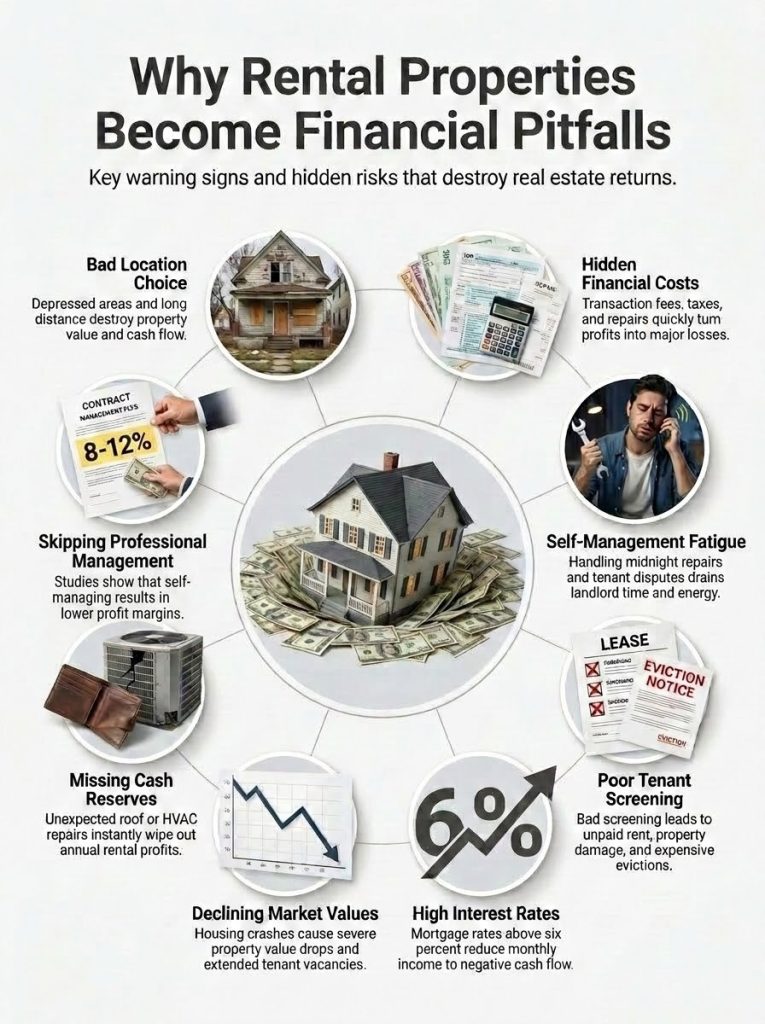
Why Rental Properties Can Be a Bad Investment
Rental properties drain your capital when you make poor decisions about location, finances, or management. Bad tenant screening, self-management mistakes, and surprise repair costs turn many landlords into broke investors who regret their strategy.
Poor Choice of Location
Location makes or breaks your investment. Pick the wrong area, and your property appreciation stops cold.
Economically depressed markets destroy wealth fast. Properties in these zones sit vacant for months. Tenants avoid them, and landlords struggle to collect rental income.
Dr. Jim Dahle learned this the hard way. He purchased a property at the peak of the housing bubble in 2006. Las Vegas properties averaged $299,000 that year. The market crashed hard.
By 2012, those same homes fell to just $109,000. According to Greater Las Vegas Association of Realtors data reported in 2023, and separately confirmed by Zillow’s Home Value Index, median prices eventually climbed back to roughly $430,000 to $495,000 by 2023. That extreme swing from $109,000 to over $430,000 in just over a decade shows exactly how volatile location-driven risk can be.
Dahle took a massive loss on his investment property. One investor waited a full decade to sell his property, and he still lost money. These stories show how location destroys your cash flow and your entire portfolio.
Distance compounds location problems dramatically. The property sat 2,218 miles from the owner’s home in Utah. Managing a property from far away creates real headaches.
Legal issues pop up. Maintenance requests pile up. Tenants need quick answers you cannot give.
The property also sat in a flood zone, requiring expensive flood insurance that ate into rental income. Homes in certain neighborhoods appreciate slower than others too. Your cap rate suffers, your debt service coverage ratio drops, and your tax benefits shrink.
The location you choose today determines the financial loss you face tomorrow.
Insufficient Financial Planning
Many investors jump into rental properties without doing the math first. Jim Dahle learned this lesson the hard way.
He purchased a property for $138,000 and sold it for $114,500. That meant an initial loss of 17%. After he added in improvements and costs, his adjusted loss climbed to 22%.
Closing costs alone took another 3% of the sale price, adding $3,400 to his losses and pushing the total to 25%. Renovation and repair costs of approximately $6,000 contributed to a 29% loss. Realtor fees of 6% on the sale price totaled $7,000, bringing his cumulative loss close to $60,000 on that single property.
This real-world example shows how poor financial planning destroys wealth fast. You must calculate mortgage rates, property taxes, mortgage interest, and all other expenses before buying.
| Expense Category | Amount | Cumulative Loss % |
|---|---|---|
| Initial Sale Loss | $23,500 | 17% |
| Improvements & Costs | Added expense | 22% |
| Closing Costs (3%) | $3,400 | 25% |
| Renovation & Repairs | ~$6,000 | 29% |
| Realtor Fees (6%) | $7,000 | ~$60,000 total |
Distance and specialized insurance can dramatically shrink your projected returns. One remote owner managing a single-family rental from over 2,000 miles away ran detailed cash flow projections.
The property collected $3,850 in rent monthly. After subtracting the $2,400 mortgage payment, 10% property management fee of $385, $150 average for remote inspection and travel costs, $200 repairs reserve, and $250 for insurance including flood coverage, monthly profit dropped to just $465 before vacancy.
Adding one month of vacancy per year reduced the average monthly profit to only $129. The distance and added insurance costs cut projected profits by roughly 70 percent compared with an owner-on-site estimate.
Stock market investments and index funds offer better liquidity and lower transaction fees compared to real estate. Per a BiggerPockets analysis of NCREIF Property Index data, with 2024 figures from NCREIF’s Q4 2024 release, the S&P 500 returned an annualized 11.53% over 1978-2022 versus 9.03% for the NCREIF Property Index. But in 2024 specifically, the NCREIF NPI posted just a 0.59% total return for the full year, reflecting the rate-driven downturn in property values.
This gives you a concrete comparison to weigh against real estate. Property returns can swing wildly year to year, not just in theory.
WealthyDoc notes that high transaction fees and upgrade costs rarely get recouped on rental properties. Your cash-on-cash return suffers when you skip the financial planning stage.
Tools like a buy versus rent calculator help you compare your options. Successful rental investors use professional guidance to build solid investment strategies. You need to understand cap rates, depreciation, and capital gains tax implications before signing papers.
Financial boot camp programs teach landlord responsibilities and wealth management principles that protect your money. Consider diversification across bonds, stocks, and real estate investment trusts rather than putting all your cash into single-family rentals or multifamily properties.
Tax advantages exist in real estate, yet they only help if your deal makes financial sense from the start. Emergency funds for repairs and vacancies must sit in your budget before you close on any property.
Challenges in Self-Managing the Property
Self-managing a rental property turns into a part-time job that demands your constant attention. You handle late-night repair calls, vet tenants, and perform regular upkeep on your own dime and time.

Vacancy gaps create zero rental income while you still cover mortgage payments, property taxes, and insurance costs. Distance management complicates everything further. You cannot inspect problems in person or respond quickly to tenant issues.
Professionals like those at High Yield Landlord and The White Coat Investor recognize that skills in medicine or finance do not transfer to property management. You must collaborate with handymen, lawyers, and credit agencies to screen tenants properly and handle disputes. This coordination adds layers of complexity that drain your energy and resources.
Professional property management services typically cost 8% to 12% of your rental income, but they significantly improve your occupancy rate and lower your vacancy rate compared to self-management, wherein you assume full liability for structural flaws and tenant conflicts, exposing yourself to legal and financial risks.
Self-managing in high-interest rate periods or economically depressed markets like San Francisco compounds these challenges. Rent control laws in certain areas limit your income potential while maintenance responsibilities remain your burden.
Outsourcing maintenance to a team of tradesmen or handling it personally both consume your time and money, leaving you with fewer profits than you anticipated. The decision to self-manage versus hire professionals shapes whether your rental investment succeeds or fails.
Inadequate Tenant Screening
Managing your property yourself creates another major problem: poor tenant selection. Screening tenants requires data analysis and people management skills that most landlords lack.
One investor experienced a year’s worth of unpaid rent from a single tenant facing financial hardship. That situation forced them to sell the property at a profit in late 2022, but not before losing significant income.
A closer look at one screening failure shows exactly how costly these mistakes become. Over an 18-month period, a single unit experienced five separate instances of payments more than 30 days late, one stretch of 180 days without payment, and eviction costs totaling $6,400.
The total amount of lost rent, legal fees, and turnover costs was equal to 11 months of rent. The tenant passed a surface credit check but failed secondary income verification. That single oversight produced nearly a year’s worth of lost revenue.
According to Eviction Lab at Princeton University’s 2025 tracking data, roughly 7.9% of renter households faced an eviction filing in 2025. This figure shows exactly how common non-payment and eviction risk actually is. Rigorous tenant screening is not optional; it addresses a real, quantifiable threat to your cash flow.
Inadequate screening results in unreliable tenants who damage your cash flow and create extended vacancy periods. You must verify income, check credit reports, and contact previous landlords before signing any lease.
Professionals who work in financial independence planning understand that rental income requires careful vetting. Your tenant selection process directly affects your bottom line and your ability to cover expenses such as mortgage interest.
Bad tenants cost more than bad properties, so screen carefully or risk losing everything.
Local laws and lease agreements determine how you handle problem tenants, but prevention beats enforcement every time. If a tenant fails to pay rent on time, your lease terms and state laws dictate your next steps.
Government regulations can block eviction processes, as happened during the COVID-19 pandemic, leaving landlords stuck with non-paying occupants. Habitual late payments require late fees and stricter measures, but eviction processes vary by location.
You should leave tenant screening to experienced professionals who possess the skills and tools to identify reliable renters. This approach protects your investment and ensures consistent rental income without the stress of managing problem situations.
When Rental Properties Are a Bad Investment
Certain times make rental properties risky bets. You need to understand exactly when to stay away from this investment type.
During High-Interest Rate Periods
High mortgage rates create serious problems for rental property investors. Rates above 6% to 7%, paired with cap rates below 5% to 6%, produce negative cash flow when financed with debt.

As of mid-2026, per The Mortgage Reports and AmeriSave rate data from July through August 2026 and cap rate benchmarks from CBRE’s H2 2025 report and Rentana’s Q1 2026 report, investment-property mortgage rates run roughly 7.1% to 7.8%. That’s about a point above the 6.6% to 6.8% rate on owner-occupied 30-year loans. Average cap rates for residential and multifamily rentals sit around 4.75% to 5.6%.
This directly shows the problem. Your monthly mortgage payments eat up rental income fast. You lose money each month instead of building wealth.
Property taxes and insurance costs climb higher during inflationary periods, making losses worse. One investor bought a house in Virginia in 2007 for $252,000 and lost money every single month while renting it out. That investor faced the harsh reality that high financing costs destroy profit margins.
Financial planning tools like those offered through platforms such as Wealthfront help you calculate these risks before you buy. Professional advisors at firms like Leonberg Capital can show you exactly how rate changes affect your returns.
Adjustable rate mortgages amplify this danger significantly. A VA ARM loan resets in two years, which means your monthly payments can jump up. These loans increase by a maximum of 1% per year with a total cap of 5% over the life of the loan.
Your comfortable payment today transforms into a painful expense tomorrow. Market data from sources like Seeking Alpha reveals how mortgage rate volatility turns profitable properties into loss-making investments fast.
You must understand these risks before signing any loan documents. Avoiding rental property investments during high-interest rate periods protects your financial security.
In Declining or Economically Depressed Markets
Market crashes create serious problems for rental property owners. Las Vegas shows how fast property values can drop.
Homes averaged $299,000 in 2006, fell to just $109,000 by 2012, then climbed back to over $430,000 by 2023. This wild swing hurt many investors who bought at the peak.
| Year | Las Vegas Median Home Price | Change |
|---|---|---|
| 2006 | $299,000 | Peak |
| 2012 | $109,000 | -64% |
| 2023 | $430,000+ | +294% |
Doctor K purchased an overpriced condo in Washington, DC, right before the 2008 market crash destroyed her investment. MM bought a condo for $400,000 in 2005 and later became an accidental landlord. The property sold for only $300,000 in 2015, costing her $100,000 in losses.
These stories show that declining markets punish landlords who lack solid financial planning and expert guidance from professionals like those at Fidelity or CFA-certified advisors.
Vacancy rates spike in economically depressed areas, making it tough to earn rental income. Dr. Jim Dahle’s property sat empty for 1.5 years while he tried to sell it, draining his cash reserves with no tenants paying rent.
Iglord bought a property in 2010 for $145,000. It lost value and now sits at about $135,000. HDMD invested $126,000 in a property in 2006, then spent over $40,000 on repairs before renting it out briefly in 2012.
Short-term rentals and traditional leases both struggle in these markets because fewer people move to economically depressed regions. Property management services and thorough financial planning become critical tools to protect your money in these risky situations.
Without an Emergency Fund for Repairs or Vacancies
Landlords who skip building an emergency fund set themselves up for serious trouble. One investor reported making a $1,600 monthly profit, yet emphasized that unexpected maintenance costs can destroy that gain fast.
Anticipated monthly repairs average $200 or more, cutting deeply into earnings. A Reddit user factored in one month of vacancy per year, which equals a monthly cost of $160. These numbers add up quickly and shrink your actual profit.
Conservative projections reveal how fragile rental margins become without substantial reserves. Consider a property purchased for $250,000 generating $1,600 monthly rent.
Recurring monthly costs include a $1,100 mortgage, $150 in taxes, $80 for insurance, $200 maintenance reserve, and 8% management fee of $128. That totals $1,658, creating a negative $58 monthly result before any vacancy.
One month of vacancy per year adds another $133 monthly reduction to your average. With these conservative numbers you need over ten grand in reserves before the deal stops being a one-month surprise away from disaster.
A recommended reserve of three months of total expenses equals $10,644 for this property. This shows exactly why inadequate cash cushions turn small setbacks into complete financial failures.
Major capital expenses like roof replacements or HVAC repairs can wipe out years of profit in just weeks. Buyers without adequate cash reserves face financial hardship when expensive repairs hit or tenants stop paying rent.
Property owners who experienced non-paying tenants and lengthy vacancy periods learned this lesson the hard way. They discovered that skipping a reserve fund forced them into tough corners.
Vacant properties drain your wallet while you hunt for buyers. Owners must continue paying the mortgage without any rental income coming in. Failure to maintain a reserve for unexpected costs can force owners to sell at a loss.
This scenario plays out across real estate markets, from nnn properties to bx portfolios. Smart investors like jussi askola and andy rachleff understand that cash reserves protect your investment.
Building your emergency fund before you buy protects you from financial ruin. Start saving three to six months of expenses before you purchase any rental property.
According to Fannie Mae and Freddie Mac underwriting guidelines, reserve requirements actually vary significantly by lender. Fannie Mae requires 6 months of PITI (principal, interest, taxes, insurance) reserves for investment property loans, while Freddie Mac requires as little as 2 months for 2-4 unit investment properties.
This shows the three- to six-month rule is a reasonable, informal industry consensus, but readers financing through different lenders may face stricter or looser official requirements.
Your future self will thank you when repairs pop up or tenants leave unexpectedly.
How to Avoid Pitfalls and Make Rental Properties Profitable
You can turn your rental property into a money-maker by getting smart about your choices from day one. Smart investors use financial planning, location research, property management services, and tenant screening to build wealth instead of stress.
Conduct Thorough Financial Planning with Expert Guidance
Many rental property investors fail because they skip crucial financial planning steps. Dr. Jim Dahle emphasizes that a deliberate approach is vital to avoid losses in real estate. You must calculate all costs before purchasing a property. Check our ROI Calculator here.
Transaction fees, vacancy rates, and repair costs often surprise new landlords. Several investors report that failing to factor in these expenses led to poor returns.

A buy versus rent calculator tool helps you compare costs. Expert guidance from financial professionals prevents costly mistakes. Lawyers, accountants, and real estate advisors offer valuable insights. These professionals help you understand tax implications and liability issues.
Working with experienced team members protects your investment. Financial planning tools reveal whether a property makes economic sense.
The White Coat Investor states that home ownership has contributed minimally to their net worth compared to other wealth-building methods. This fact shows that real estate is not always the best investment path. Thorough analysis separates profitable deals from financial disasters.
Professionals guide you through complex calculations and market analysis. Credit agencies provide tenant information that affects your rental income. Handymen and contractors estimate repair costs accurately. Lawyers draft solid lease agreements and protect your legal rights.
Financial advisors help you structure deals for maximum returns. Expert guidance ensures you only purchase properties where prices do not significantly exceed renting costs.
Dr. Jim Dahle’s emphasis on deliberate planning applies to every investment decision. The author recommends considering buying only if planning to stay at least five years. This timeframe allows you to recover transaction costs and build equity.
Syndication offers an alternative investment route, but it requires careful selection of experienced syndicators. Consulting with professionals helps you evaluate syndication opportunities properly. Financial planning with expert guidance transforms rental properties from risky ventures into solid investments.
Choose the Right Location Carefully
Your financial plan means nothing if you pick the wrong neighborhood. Location shapes your rental income and property value more than any other factor.
- Study tech worker demand in cities like Seattle to find tenants who pay premium rents and stay longer in your properties.
- Research neighborhood appreciation rates; homes in high-demand areas gain value faster than those in struggling economies.
- Avoid flood zones and areas with chronic natural disasters, as insurance costs will eat your profits and scare away quality tenants.
- Check local economic health by examining job growth, business development, and population trends in your target area.
- Analyze vacancy rates in your chosen neighborhood; properties in declining markets sit empty for months and drain your cash flow.
- Visit the property yourself rather than managing from a distance; proximity helps you spot maintenance issues and respond to tenant needs quickly.
Hire Professional Property Management Services
Picking the right location sets a strong foundation for your rental business. Professional property managers take your investment to the next level by handling the daily work that drains your time and money.

Property management services cost 8% to 12% of your rental income, but they cut your workload significantly. According to NARPM (National Association of Residential Property Managers) fee survey data and industry pricing data compiled by Buildium and All Property Management from 2025-2026, the typical core property management fee averages about 8.49% of monthly rent nationally.
But total first-year cost often runs closer to 18% to 20% once leasing and placement fees are included, which commonly run 50% to 100% of one month’s rent for finding a new tenant.
One landlord paid a manager 6% of monthly rent, which came to $231 each month, plus an additional 50% fee for new tenants. This expense might seem high at first, but professional managers handle advertising and inquiries, tenant screening, late-night repair calls, regular maintenance tasks, consistent rent collection, and documentation/paperwork. They reduce stress for owners and keep your property running smoothly.
The financial tradeoff between self-management and professional services often favors professionals despite the added expense. One owner compared results before and after hiring a manager.
| Metric | Self-Managed | Pro-Managed |
|---|---|---|
| Vacancy Rate | 12% | 4% |
| Effective Monthly Income | $1,672 | $1,824 |
| Management/Expenses | $700 | $514 |
| Net Cash Flow | $972 | $1,310 |
That represented a $338 monthly improvement despite the management fees. Paying a manager reduced gross take but increased net cash by about a third due to lower vacancy and quicker repairs.
Hiring experienced professionals proves especially important if you live far away or manage multiple properties. Property managers navigate local legal requirements for evictions and tenant disputes, protecting you from costly mistakes.
They minimize vacancy periods and fix maintenance delays quickly, which keeps your income steady. Effective management prevents small portfolios from becoming unprofitable by controlling costs carefully.
The sila of good management shines through when you avoid the headaches of self-managing. Professional teams vet tenants thoroughly, collect rent on time, and handle conflicts between you and your renters. This approach lets you focus on growing your real estate business instead of answering tenant complaints at midnight.
Leave Tenant Screening to Experienced Professionals
Professional property managers bring more than just administrative support to your rental investment. They handle tenant screening with proven expertise and established procedures.

These professionals conduct thorough background checks and income verification. They collaborate with credit agencies to pull detailed financial histories. They work with legal experts to ensure compliance with fair housing laws. This systematic approach reduces your risk of long-term non-payment and costly evictions.
Tenant screening requires specific skills in data analysis and people management. Property management companies have the tools and knowledge to evaluate credit reports, criminal backgrounds, and rental histories.
Experienced professionals catch red flags that inexperienced landlords miss. They maintain consistent screening standards across all applicants. This is especially critical in high-turnover markets where maintaining steady cash flow matters most.
Outsourcing this task protects your investment and keeps your property occupied with reliable tenants who pay on time.
Conclusion
Rental properties demand more than money. They require time, skill, and smart planning.
You must pick the right location, screen tenants carefully, and keep cash reserves for repairs and empty months. High interest rates and weak markets can turn your investment into a money drain, leaving you with negative cash flow each month.
Hire experts to manage your property if you lack the time or patience to handle tenant conflicts yourself. Skip rental properties if you cannot allocate for professional management, do not have emergency funds, or face rising mortgage rates in your area.
In Orlando and surrounding areas like Kissimmee, Davenport, and Clermont, you can count on Guest Managers to make your rentals operate trouble-free, even if you are from another state. Contact us today for profitable rentals, from purchasing to management, and let your investment truly work for you!
FAQs
1. When are rental properties a bad investment?
Rental properties become a bad investment when maintenance costs exceed rental income, which typically happens when annual expenses surpass 50% of your gross rental revenue. Properties in declining neighborhoods or areas with high vacancy rates often lose money. Bad timing in the real estate market can also turn rentals into poor investments.
2. Why do some rental properties fail to make money?
High property taxes, expensive repairs, and low rent prices can drain your profits quickly. In the US, investors should budget at least 1% of the property value annually for maintenance alone, and many underestimate this cost when calculating returns.
3. What makes a rental property too risky?
A rental property is too risky when you cannot find reliable tenants or when the building needs constant repairs. Properties with negative cash flow will cost you money each month instead of earning income.
4. Should I avoid buying rental properties in certain locations?
Yes, avoid areas with falling property values and high crime rates. Neighborhoods with vacancy rates above 10% make it hard to find good tenants and keep steady income.