This page tells is about how much a landlord can raise the rent in Florida and what can one do next.
There is no statewide rent control cap in Florida for most rentals. The amount usually depends on the lease, proper notice, and whether the increase is seen as discrimination or retaliation.
These are the important rules and the steps one needs to take.
Important Points
- Florida doesn’t have a statewide limit on how much rent can go up for most private rental homes. As long as the rules for the lease and notice are followed, the increase can be any amount.
- Florida law makes it very hard for cities to control rent. A local rent control measure usually needs a declared housing emergency, voter approval, and it only lasts for one year.
- Florida Statute 83.57 (as shown in the 2025 statutes) say that for periodic tenancies, notice to end a tenancy is: week-to-week 7 days, month-to-month 30 days, quarter-to-quarter 30 days, and year-to-year 60 days.
- Florida Statute 83.575 says that if a fixed-term lease has a “notice to not renew” requirement, the notice period for both sides can only be 30 to 60 days.
- The Orlando-Kissimmee-Sanford metro area will have a fair market rent of $1,972 for a two-bedroom apartment in FY 2026, up from $1,958 in FY 2025, which is about a 0.7% increase.
- Florida Statute 723.037 says that mobile home lot rent must be raised with at least 90 days’ written notice, and that right cannot be given up.
Florida Rent Increase Laws and Rent Control Rules

When it comes to the “percentage” question, Florida’s rent increase laws are clear: most private rentals don’t have a statewide rent cap.
The most important thing is that the rent change follows the law for landlords and tenants, the lease, and fair housing rules.
No statewide rent control
In Florida, rent increases usually don’t have a limit. Local rent control is only allowed in rare housing emergencies that get a vote and only last for a year.
Florida law says that local governments can’t control rent unless there is a housing emergency that is so bad it threatens the public and the local voters agree to it.
State law says that any rent control measure only lasts for one year and must be re-adopted under the same strict rules to stay in effect.
Most renters don’t know this, but the rent control law doesn’t cover all types of housing. For example, it doesn’t cover seasonal or tourist units, second homes, or “luxury apartment buildings,” which are defined as buildings with an average monthly rent of $250 or more on January 1, 1977.
Local governments can still help make housing more affordable in other ways, such as through inclusionary housing and other land-use tools. However, these are not the same as a rent cap.
Rent increases based on the market
Landlords usually set renewal rent based on how much people want to rent, how much it costs to run the property (including property taxes and insurance), and how much similar rental homes are renting for nearby.
HUD Fair Market Rent (FMR) is a good way to check the sanity of a renewal price, especially if comparing neighbourhoods in the same metro area.
| HUD FY 2026 2-Bedroom FMR (Effective Oct. 1, 2025) | 2BR FMR |
| Orlando-Kissimmee-Sanford | $1,972 |
| Tampa-St. Petersburg-Clearwater | $1,978 |
| Miami-Miami Beach-Kendall | $2,436 |
| Fort Lauderdale | $2,333 |
To make a plan that works, a tenant can look at 5 to 10 listings in the area that are similar, compare them to their current rent, and then decide whether to negotiate, renew, or move.
Using standard rental property management methods, landlords and property managers often keep an eye on these comps and rental trends.
Florida’s Legal Rent Increase Percentage
There is no statewide limit on how much rent can go up in Florida.
That means that the “legal” limit is usually set by the terms of the rental agreement, proper notice, and whether the increase is unfair or retaliatory.

No specific legal limit
There is no limit on how much rent can go up in Florida, so it can go up by 5%, 20%, or more. However, it must still follow the lease and Florida landlord-tenant laws.
A landlord can usually raise rent by any amount when the lease is up for renewal, as long as they don’t break a fixed-term lease, violate a required notice clause, or use the increase to discriminate or retaliate.
Comparing the lease term, notice timing, and the reason (or pattern) behind the increase side by side is the quickest way for a renter to check the “legality.”
- Lease term: Fixed-term leases usually keep the rent the same until the lease ends, unless the lease clearly says that it can be changed.
- Notice: Florida Statute 83.57 sets deadlines for written notice for periodic tenancies (week-to-week, month-to-month, quarter-to-quarter, and year-to-year).
- Fairness under the law: If a rent increase is based on discrimination or retaliation, it could be against the law.
What “market increases” really mean
Instead of trying to figure out if a 3% to 10% increase is “normal,” look at real comps and an objective standard like HUD FMR for the area.
For instance, HUD’s FY 2026 FMR for a two-bedroom apartment in Orlando-Kissimmee-Sanford is $1,972, which is $14 more than the FY 2025 FMR of $1,958.
If the renewal rent is much higher than what other homes in the area are going for, one shouldn’t just assume it’s illegal. The tenant should either negotiate or plan to move.
Notice Requirements for Rent Increases
Most of the time, a written notice of a new rent amount that will apply to the next rental period or at renewal is how rent increases are given.
Florida Statute 83.57 states that the notice period for periodic tenancies varies based on the type of tenancy, while Florida Statute 83.56(4) outlines the required method for sending the notice.
If a tenant gets help with housing, check with the U.S. to see if their program has extra steps for notice or approval steps through the U.S. Department of Housing and Urban Development.
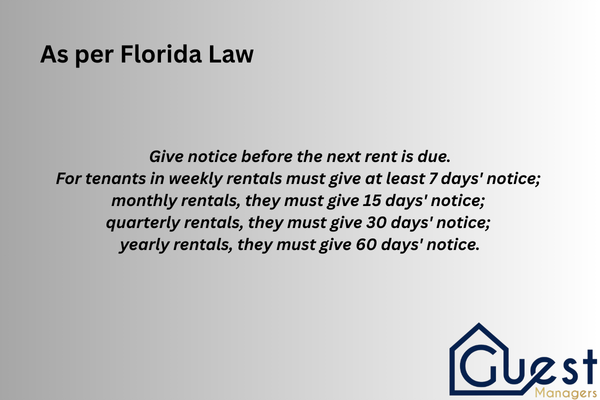
| Tenancy type | Minimum written notice to end the tenancy (commonly used as a timing guide for rent changes) |
| Week-to-week lease | 7 days |
| Month-to-month lease | 30 days |
| Quarter-to-quarter lease | 30 days |
| Year-to-year lease | 60 days |
Month-to-month leases
Florida Statute 83.57 says that for a month-to-month lease, the tenant must give the landlord 30 days’ written notice before the end of the month.
If the tenant gets a notice of a rent increase too late in the month, they can argue that the increase can’t happen until the next rental period.
Florida Statute 83.56(4) also says that delivery of required notices can be done by mailing or delivering a true copy, or by leaving a copy at the tenant’s home if they are not home.
Long-term leases
The rent is usually set for the whole term of a fixed-term lease (like 6 months or 12 months) unless the lease agreement clearly says that the rent can be changed in the middle of the lease.
The renewal notice clause is something that a lot of renters don’t know about. Florida Statutes 83.575 says that if the lease requires a “non-renewal” notice, the notice period can’t be less than 30 days or more than 60 days for either party.
If the lease doesn’t say anything about a renewal notice, the safest thing for the tenant to do is to ask for the renewal terms in writing well before the lease ends so they have time to look at their options.
Can a Landlord Raise Rent During a Lease Term?
Generally, the answer is no. A landlord can’t usually raise the rent while a lease is in effect unless the lease says they can.
A tenant can fight the change under Florida landlord-tenant laws.
- If a tenant’s lease is for a set amount of time, the rent usually stays the same until it ends.
- If the lease has a rent-adjustment clause, one must follow it exactly, including when one have to give written notice.
- If one rents by the month, the landlord can raise the rent for the next month with proper written notice. The tenant can either accept the new rate by staying or move out before it goes into effect.
Rent-increase rules for government-subsidized housing
When the government pays for housing, there may be extra rules that don’t apply to rent changes in the private market.
Don’t think that the landlord can just “pick a number” and apply it; programs often need approvals, tenant notices, and timing that is linked to annual recertifications.
Section 8 housing and HUD standards
Several federal housing programmes use HUD Fair Market Rents (FMRs) as a standard.
The Orlando-Kissimmee-Sanford FMRs as of the HUD FY 2026 schedule (which starts on October 1, 2025) are:
| Bedroom size | FY 2026 FMR (Orlando-Kissimmee-Sanford) |
| 0 BR | $1,650 |
| 1 BR | $1,731 |
| 2 BR | $1,972 |
| 3 BR | $2,476 |
| 4 BR | $2,924 |
There are different rules for notices in mobile homes.
Florida Statute 723.037 says that if one rents a lot in a mobile home park, one must get at least 90 days’ written notice before the rent goes up. One cannot give up their right to that 90-day notice.
The law also says when meetings must happen and that the park owner must explain the important reasons for an increase in more than general terms.
When Can a Rent Increase Be Considered Illegal?

If a rent increase breaks the lease, doesn’t follow the rules for giving notice, or is discriminatory, retaliatory, or emergency price gouging, it could be illegal in Florida.
Pay attention to the “why”, the timing, and the paper trail.
- Lease violation: raising the rent during the lease without a good reason.
- Bad notice: trying to change the rent amount without giving the required written notice for the type of tenancy.
- A discriminatory rent increase is when the tenant is being treated differently because of a protected trait under fair housing laws.
- Retaliatory rent increase: raising the rent because the tenant did something legal, like reporting a code problem.
- Price gouging during a state of emergency: Florida law says that during a declared emergency, it is illegal to charge unreasonable prices for renting or leasing a home for up to 60 days (and longer if an executive order extends the time).
Increases based on discrimination
The federal Fair Housing Act and Florida’s fair housing law say that a landlord can’t discriminate against people based on their race, colour, national origin, religion, sex, disability, or family status.
The tenant can file a complaint with HUD or the Florida Commission on Human Relations. if they think a rent increase is because of discrimination.
The Commission states that, in most cases, a complaint about housing discrimination must be filed within one year of the last alleged discriminatory act.
Retaliatory increases
Florida Statute 83.64 says that a landlord can’t raise the rent unfairly just because a tenant acted in good faith.
The law lists some actions that tenants are allowed to take, such as reporting a building, housing, or health code issue to a government agency, telling the landlord about a violation, or exercising their rights under fair housing laws.
If the tenant thinks the rent increase is a retaliation, they should keep the timeline: repair requests, photos, code reports, emails, and the notice of the rent increase.
How to Manage Rent Increases Legally
If you’re a landlord or property manager, the best thing to do is treat a rent change like a compliance project, not an email.

Clear notice, consistent paperwork, and fair treatment lower the number of disputes and protect the rights of tenants.
Providing proper notice
- Make sure the kind of lease agreement is clear: fixed-term or periodic (month-to-month, week-to-week, quarter-to-quarter, or year-to-year).
- Look for a clause in the lease that says you can renew it. Florida Statute 83.575 says that if it does exist, it can only last for 30 to 60 days.
- Write a letter to your tenant telling them about the rent increase, including the new amount and the date it will take effect.
- Send the notice in a way that you can prove, like with a letter with a date on it, proof of mailing, and saved copies.
- Don’t try to use the increase before the next rental period or renewal date.
Justifying the rent increase
Most private landlords don’t need a “reason” to raise rent, but if someone challenges the increase, you do need to be able to prove that it is fair and legal.
Good records include comparable listings, repair invoices, and a policy that you use on all units that are the same.
Tenants can get current local listings, like, for example, the: current Miami Beach controlled-access apartment listings., to help them make a comps packet quickly and easily.
Advice for Tenants Facing Rent Increases
Check your lease first, then check the notice time, and finally choose whether to negotiate, renew, or move.
You can read the federal Fair Housing Act overview to learn the basics of federal fair housing and see some examples.
Knowing your rights under Florida law
- Fixed-term lease: The rent usually can’t change until the lease is up, unless your lease says it can.
- Month-to-month lease: You should usually get written notice at least 30 days before the end of the lease, as required by Florida Statutes 83.57.
- Retaliation: Florida Statutes 83.64 says that landlords can’t raise the rent in response to protected tenant actions.
Keeping your security deposit safe
If your rent goes up, your security deposit doesn’t automatically change. But if you move out because your rent goes up, that’s when deposit rules are most important.
Florida Statutes 83.49 makes it clear what the deadlines are after you move out:
- If the landlord doesn’t make a claim, the deposit usually has to be returned within 15 days of the lease ending.
- If the landlord plans to file a claim, they usually have to send a notice of intent within 30 days. You usually have 15 days after you get the notice to write an objection.
Looking into ways to negotiate
If the new rent seems too high, consider approaching it as a business negotiation to seek a more favourable agreement.
- The tenant can request the renewal terms in writing and kindly ask for a brief period to respond, allowing you to plan accordingly.
- Give them something real, like a longer lease renewal, a mid-lease inspection, autopay, or the option to move in on a different date.
- If the tenant plan to stay for a long time, suggest a phased increase, like part now and part in 3 to 6 months.
- If the tenant thinks they are being discriminated against or retaliated against, keep everything in writing and keep the notice of the rent increase.
Conclusion
Florida rent control is highly restricted, and they don’t set a statewide percentage cap on most rentals’ rent increases. A tenancy agreement is the best protection to avoid legal issues.
For landlords and homeowners renting out their homes in Orlando, Guest Managers can help landlords and rental homeowners with day-to-day property management, like keeping track of rent payments, maintenance records, and lease renewals for a truly trouble-free passive income. Our dynamic pricing and aggressive advertising help maximize occupancy and profit. Contact us today!
Questions and Answers
1. How much can a landlord raise rent in Florida?
There is no statewide limit on how much rent can go up. Landlords can raise rent by any amount when a lease ends or on a month-to-month lease. However, they must follow Florida rent increase laws, give proper notice of the increase, and pay attention to local government rules.
2. Is there rent control in Florida?
There is no statewide rent control in Florida, and the state’s rent control laws are limited. Check to see if the city or county has its own rent control law.
3. How long does a landlord have to give notice before they raise the rent?
For a month-to-month lease, landlords usually give a notice of a rent increase at least 15 days before the end of the rental period. For a week-to-week lease, they give a notice of a rent increase at least 7 days before the end of the rental period. For a fixed lease, they wait until the lease term ends or the lease is renewed.
4. Is it legal for a landlord to raise the rent to get back at a tenant?
No, a rent increase in response to a tenant’s complaint is against the law. Tenants have rights under Florida landlord-tenant laws, the federal Fair Housing Act, and HUD (the Department of Housing and Urban Development) if the increase is used as harassment or discrimination.
5. Can landlords raise the rent because of rising prices or the cost of living?
Yes, landlords can raise rent to cover higher costs, inflation, and living costs. However, they must follow rules for managing rental properties and collecting rent, as well as make sure that housing is affordable and available.
6. If tenants get a big rent increase or an eviction notice, what can they do?
Tenants should read the lease agreement, write down the dates for renewing the lease, check their legal rights, call HUD (the Department of Housing and Urban Development) or a local legal aid group, keep records to fight unfair rent increases or harassment, and make a budget for their rent, security deposit, and living expenses.