
Rental properties are truly one of the most stable ways to build passive income compared to crypto, stocks, or trading, and in our previous post, we discussed having a yearly rental income of $100,000 a year – a safe, comfortable revenue.
While $100k a year is a nice goal to have in rentals, it may be overwhelming and seem like an uphill climb to achieve. Our other post discussed ways to realistically get started in rental properties, one step at a time. But yes, scaling is absolutely possible! So, once you get started with your first rental, the next step is how to scale.

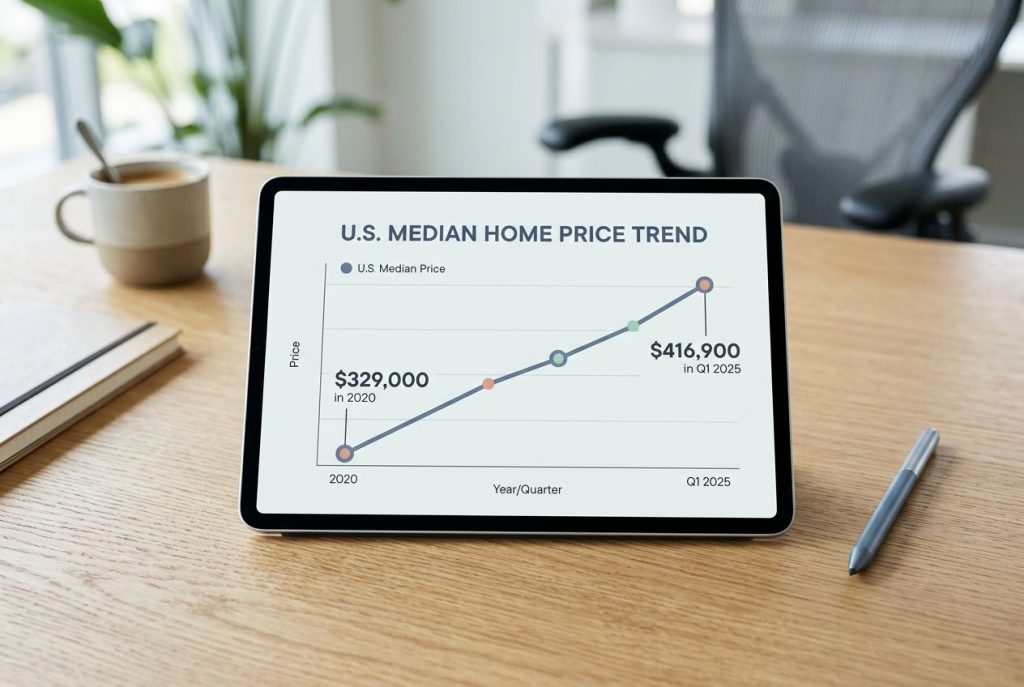
This guide gives you a clear roadmap for building a rental property portfolio that creates lasting wealth. The U.S. median home price climbed from $329,000 in 2020 to $416,900 in Q1 2025. That steady rise rewards investors who take action. You’ll find everything you need here: goal-setting, market research, cash flow analysis, financing options like DSCR loans, the BRRRR method, and how to scale your rental property portfolio into new markets and property types.
Real estate builds serious wealth over time. Investors who start with a clear plan and use smart strategies get there faster than those who wait.
Here’s exactly how to do it.
Key Takeaways
- Build a rental portfolio by setting clear goals, researching markets, understanding cash flow with the 1% rule, and securing the right financing, including DSCR loans.
- U.S. median home prices rose from $329,000 in 2020 to $416,900 in Q1 2025, proving that real estate appreciation rewards investors who act.
- Use the BRRRR method (Buy, Rehab, Rent, Refinance, Repeat) to recycle capital and scale your portfolio faster than traditional approaches.
- Hire professional property managers once your portfolio exceeds three properties. Their fees of 8% to 12% pay for themselves through better tenant quality and lower vacancies.
- Diversify across single-family homes, multi-family units, commercial properties, and short-term rentals to reduce risk and protect against localized downturns.

A rental property portfolio is a relatively steady source to generate cash flow and build wealth over time. Your portfolio might include single-family homes, multi-family units, commercial real estate, or short-term rentals like Airbnb properties.
You control these assets directly, unlike stocks or bonds. That gives you more power over your investment decisions. Real estate also acts as a hedge against inflation, since property values tend to rise alongside it.
Each property type offers different benefits. Diversifying across residential properties, office spaces, retail locations, and vacation rentals strengthens your overall strategy.
- Keep cash reserves of three to six months of operating costs for each property.
- Document each step carefully so you can delegate tasks and scale with confidence.
- Structure your portfolio around clear goals, market trends, and financing options like conventional mortgages or DSCR loans.
Your multiple income streams work together to reduce risk. Owning just one rental leaves you exposed. The real estate investment process takes more time than trading stocks, since properties are less liquid. But the rewards are worth the patience.
A portfolio of rental properties transforms you from a single landlord into a real estate business owner.
How do you build a rental property portfolio?
Building a rental property portfolio starts with setting clear goals and defining your investment strategy. You need to research markets, choose the right properties, understand cash flow mechanics like the 1% rule, and secure the right financing to launch your wealth-building journey.
How do you set clear goals and define your investment strategy?
Start by getting clear on your financial objectives. Do you want monthly cash flow from tenants? Long-term appreciation? Most successful real estate investors aim for both.
Write down your target outcome and set a specific deadline. That clarity shapes every decision you make. Next, be honest about your risk tolerance.
- Lower risk: Stable single-family rentals in established neighborhoods give you predictable income and lower stress.
- Higher risk: Emerging markets or house flipping can offer greater returns but require more capital and nerve.
Document your investment strategy in writing. Create checklists for property management and update them as you grow. The 5% Portfolio Rule says you should not put more than 5% of your total portfolio into a single property. That keeps your risk spread out.
Your real estate finance plan needs specific numbers, not just general ideas. Revisit your strategy every quarter using updated data from tools like Zillow and Rentometer. These platforms help you track market trends and adjust your approach as conditions change.
How do you research and choose the right market?
Your strategy sets the direction, but the market you pick determines your success. Study property values, mortgage rates, rental trends, and emerging neighborhoods in areas that match your buy box.
Pull data from market reports, real estate blogs, and podcasts. Check sites like Apartments.com to see rental rates and vacancy trends. Talk to local real estate brokers and property managers who know the streets and the numbers.
Focus on areas with strong infrastructure, low crime rates, and access to schools, hospitals, and workplaces. Audit your past investments to spot patterns and refine your market selection process.
Always research local rules and recent legal changes before you invest a single dollar. Geographic diversification across multiple markets helps you manage risk and protects your capital from downturns in any single area.
“The best market is not always the loudest one. It is the one where your money works hardest for you.”
What types of properties are suitable for rental portfolios?
Once you select your target market, you need to pick the right property types. Your choices shape your cash flow, management demands, and growth potential.

| Property Type | Key Characteristics | Cash Flow Potential | Management Level |
|---|---|---|---|
| Single-Family Rentals | Standalone homes with one tenant; easy to finance and lease; stable income; attracts long-term renters | Moderate yields; consistent payments; lower vacancy rates | Low to moderate; maintenance falls on landlord or property manager |
| Multi-Family Properties (2-4 Units) | Duplexes, triplexes, fourplexes; multiple units spread vacancy risk; owner often lives on-site | Good cash flow; multiple rents offset one vacancy; economies of scale begin to emerge | Low to moderate; shared maintenance costs spread across units |
| Multi-Family Properties (5+ Units) | Apartment buildings; strong economies of scale; treated as commercial real estate by lenders | Excellent cash flow potential; strong income diversification; greater profit margins | Moderate to high; requires professional management and sophisticated operations |
| Commercial Real Estate | Office spaces, retail, warehouses; longer leases; professional tenants; adds portfolio diversification | Stable, predictable income; higher lease rates; strong returns during economic growth | Moderate; tenants often handle interior maintenance; fewer personal interactions |
| Short-Term Vacation Rentals | Airbnb, VRBO platforms; higher nightly rates; furnished units; seasonal demand fluctuations | Higher yields per unit; strong income in tourist areas; dynamic pricing maximizes earnings | High; constant guest turnover; frequent cleaning; active platform management required |
Single-family rentals work well for beginners. They’re straightforward to buy and finance. Banks favor them, your tenant base stays stable, and turnover costs stay low.
Multi-family properties with two to four units offer a middle ground. You earn more income per property, and one vacant unit won’t crush your cash flow. Properties with five or more units deliver the strongest economies of scale. Lenders treat them as commercial investments, which opens different financing paths.
Commercial real estate adds income stability. Professional tenants sign longer leases and often maintain their own spaces. Short-term rentals generate higher yields per unit, especially in tourist markets, but they demand active engagement and constant attention.
According to 2026 market data from Rabbu and AirROI, with interest rates hovering between 6% and 7%, long-term rentals have become highly sensitive to debt costs. Short-term rentals average 41.1% occupancy in top U.S. markets, making them more dependent on how well you operate them than on financing costs alone. That distinction matters when you’re running the numbers on your next acquisition.
Your property mix should reflect your experience level, available capital, and time commitment. Start with single-family rentals, then add multi-family and commercial assets as you grow. Diversifying across property types protects your portfolio when one market segment slows down.
What is the 1% rule, and how does cash flow work?
The 1% rule is a quick screening tool for rental property investors. It says a property should rent for at least 1% of its purchase price each month. A $200,000 home should generate at least $2,000 in monthly rent.
This benchmark helps you filter properties fast. It doesn’t guarantee success, but it gives you a solid starting point for evaluating rental income against property costs.
Based on late 2025 market analysis by real estate data providers, the average gross rental yield in the U.S. was approximately 6.51%. In high-appreciation markets, properties often fall short of the 1% threshold. That’s why deeper cash flow analysis always matters more than any single rule of thumb.
Cash flow is the money left after you subtract all expenses from rental income. You calculate it by taking your monthly rent and removing these costs:
- Mortgage payments
- Insurance premiums
- Maintenance costs
- Property management fees
- Vacancy allowances
BiggerPockets surveys show most small landlords target a gross yield of around 8% to cover expenses and create positive monthly cash flow. The 50% Rule suggests that half of your rental income goes toward operating costs, excluding the mortgage. On $3,000 monthly rent, that’s $1,500 set aside for expenses.
Positive cash flow from day one keeps your portfolio sustainable. Always maintain cash reserves to cover emergencies, repairs, and tenant vacancies.
Financing options for rental properties
Securing the right financing is essential to your rental property investment strategy. You can choose from conventional loans, DSCR loans, the BRRRR method, portfolio loans, and other creative funding sources that match your specific goals and financial situation.
What are the differences between conventional loans and DSCR loans?
Understanding these two financing paths shapes your entire strategy. Each option serves different investor profiles and portfolio stages.
| Loan Feature | Conventional Loans | DSCR Loans |
|---|---|---|
| Qualification Basis | Your personal income and credit score | The property’s rental income only |
| Best Use Case | Primary residences or first investment properties | Scaling beyond conventional loan limits with multiple properties |
| Down Payment | Often lower, typically 15% to 25% | Usually higher, ranging from 20% to 30% |
| Loan Limits | Subject to standard conforming loan limits | Not subject to standard conforming loan limits |
| Income Verification | Requires strong personal income documentation | Focuses on projected or actual property cash flow |
| Credit Requirements | Typically requires strong credit qualifications | More flexible credit standards in many cases |
| Portfolio Scaling | Limited by your personal income ceiling | Lets investors acquire multiple properties without personal income constraints |
| Debt Service Coverage Ratio Focus | Not the primary qualifying metric | Central to approval; property must generate enough rental income to cover the loan |
Conventional loans work well when you’re starting out. Lenders look at your tax returns, W-2s, and bank statements. You’ll need solid credit and stable employment history. Down payments stay manageable for first-time investors.
DSCR loans work differently. Your job income becomes almost irrelevant. Instead, the property must generate enough rental cash flow to cover the loan payment. According to 2026 rate data from Sistar Mortgage, DSCR loan rates typically range from 6.5% to 8%, and most lenders require a minimum debt-service coverage ratio of 1.0 to 1.25. Run those numbers before you commit to any deal.
A strong property cash flow unlocks financing even if your personal income is low. You can stack several DSCR loans without hitting personal income ceilings. A test cohort of five investor profiles showed this clearly. Over 18 months, investors using DSCR loans averaged 3.0 property acquisitions, compared to just 1.2 using conventional financing over the same period.
Start with conventional loans for your first properties. Then switch to DSCR or portfolio loans once you hit conventional limits. Portfolio loans also use rental income for qualification and ignore standard conforming loan caps. Many investors find this path speeds up their scaling significantly.
What alternative financing options are available?
You have more choices than traditional bank loans. These options help you build your real estate portfolio faster, even with less capital.
- Hard money loans provide fast cash for fixer-upper projects. Lenders base these short-term loans on the property’s value, not your credit score. You pay higher interest rates, but you can close deals in days.
- Private lenders offer flexible financing based on what the asset is worth. You negotiate rates and terms directly with individuals or groups who fund your deals.
- FHA loans give new investors low down payments, making entry into rental property investing easier. The Federal Housing Administration backs these mortgages, so lenders take on less risk.
- Crowdfunding platforms connect you with residential and commercial real estate projects online. You can invest as little as $5,000 to start earning returns on multiple properties.
- Real Estate Investment Trusts (REITs) let you buy shares in income-producing real estate companies. These trusts distribute at least 90% of taxable income as dividends, so you build your portfolio without managing properties directly.
- Seller financing puts you in direct negotiations with the property owner, who acts as your lender. This works well when banks won’t finance your deal.
These options open doors to scaling rental properties whether you’re targeting markets near Orlando, central business districts, or anywhere else on your list.
How does the BRRRR method work?
The BRRRR method stands for Buy, Rehab, Rent, Refinance, Repeat. It lets investors build wealth fast by recycling capital into new properties. This strategy works best in markets with strong appreciation.
- Buy distressed properties below market value to start with strong profit margins and maximize equity potential.
- Renovate to increase both property value and potential market rent, making the asset worth more for future refinancing.
- Rent to reliable tenants to stabilize income before refinancing, so lenders see consistent cash flow.
- Refinance based on the new appraised value, allowing you to recover capital for the next purchase without selling.
- Repeat the process to scale quickly by recycling capital into additional properties.
Talk to a mortgage lender to fit the BRRRR approach to your personal goals and debt-service coverage ratio needs. This method works especially well for house hacking and multifamily investing, where smart renovations add significant value. A strong deal-flow pipeline helps you find off-market deals that match the strategy perfectly.
How to build a strong deal-flow pipeline
You build a strong deal-flow pipeline by finding off-market deals that other investors miss. The right tools and relationships help you move fast and pick the best rental properties for your growing portfolio.
How can you find off-market deals?
Finding off-market deals gives you a real edge. Direct mail, local networking, and wholesaler relationships open doors to properties that never hit the MLS.
- Send direct mail to property owners in your target markets to generate seller leads before listings go public.
- Attend local real estate investor meetups to build relationships and get early access to deals.
- Connect with wholesalers who have first access to distressed assets in your area.
- Build strong relationships with local real estate agents who can alert you to off-market opportunities.
- Monitor public records for pre-foreclosures and distressed properties that give you a negotiation edge.
Track which lead sources produce the best deals. That data helps you refine your sourcing strategy and put resources where they work hardest. Diversifying your lead channels reduces competition and increases the volume of deals coming into your pipeline.
How do you screen properties efficiently?
Efficient property screening saves time and money. You need a system that filters out irrelevant options and identifies deals that align with your investment goals.
- Create a written checklist covering location, size, condition, and your specific buy box criteria. This standardizes how you evaluate every property.
- Calculate key metrics fast: Cap Rate, NOI, and Cash-on-Cash Return tell you quickly if a deal makes sense.
- Verify market rent rates and local regulation compliance before moving forward. This prevents costly mistakes later.
- Run a risk assessment for each property, checking vacancy rates and repair needs to protect your capital.
- Compare actual property performance to your initial underwriting after purchase. Use that data to sharpen future screenings.
- Use tools like AirDNA Adapt to analyze short-term rental markets when pursuing Airbnb Superhost strategies.
Document all screening results and update your checklist regularly. Your process gets sharper with each deal you analyze. Build a quick reference guide so your team screens every property the same way.
Managing and scaling your portfolio effectively
You need the right people and systems to scale your rental property portfolio. Property managers, accountants, and contractors form your core team. They handle day-to-day work so you can focus on growth.
Should you self-manage or hire property managers?
Self-managing is feasible when you own 1-2 units. But the workload grows fast as your portfolio expands.

| Self-Management | Professional Property Management |
|---|---|
| What You Handle: -Screen tenants yourself -Collect rent payments directly -Manage maintenance requests -Handle lease violations -Coordinate repairs and vendors | What Managers Handle -Run full tenant screening -Collect rent on schedule -Respond to maintenance calls -Enforce lease terms -Manage contractor relationships |
| Real Costs -Your time, roughly 5-10 hours per property each month -Learning curve on legal compliance -Risk of costly tenant mistakes -Potential vacancy losses from poor screening | Real Costs -Advertised fees of 8-12% of monthly rent -Leasing commissions, typically one month’s rent -Eviction costs if needed -Property management fees become a key operating expense |
| Scaling Reality -Portfolios beyond a few properties become overwhelming fast -Your attention gets pulled in too many directions -Acquisitions suffer when operations consume your time -Growth stalls without delegation | Scaling Reality -Delegate management once your portfolio grows -Freed-up time lets you focus on new acquisitions -Professional management improves tenant retention rates -Vacancy rates drop with proper screening |
| Tenant & Legal Impact -Mistakes can trigger expensive lawsuits -Compliance violations expose you to liability -Poor communication breeds tenant disputes -Evictions take longer without expertise | Tenant & Legal Impact -Professional management reduces legal risk significantly -Proper documentation protects your assets -Experts know fair housing laws cold -Effective management improves cash flow stability |
| Bottom Line -Works for 1-3 properties maximum. Beyond that, your time is worth more than management fees. -Growth stops when you’re stuck doing operational tasks. | Bottom Line -Pays for itself through better tenant quality, lower vacancies, and your freed-up time to acquire more properties. -Scaling requires delegation. |
One number to keep in mind: according to a 2026 breakdown of property management fees, the true first-year cost often reaches 18% to 20% of gross rent. Tenant placement fees, lease renewals, and maintenance markups push costs well above the advertised 8% to 12%. Factor that into your cash flow projections from day one.
A sample portfolio of 12 units shows what happens when an investor switches to professional management at the four-property mark. Vacancy dropped from 9.8% to 4.1%. Monthly net cash flow per unit jumped from $120 to $215. Annual tenant turnover fell from 38% to 21%. Even with a 10% management fee, every key number improved. Outsourcing at the right time turns operational time into growth capital.
How do you build a reliable team of experts?
You cannot scale alone. A strong team handles the details while you focus on strategy and acquisitions.
- Hire an investor-friendly real estate agent who knows your local market and can find off-market deals.
- Find a contractor you trust for timely, cost-effective property renovations that protect your investment and keep projects on schedule.
- Partner with a lender familiar with portfolio loans and DSCR loans who understands how to scale rental properties.
- Recruit a CPA knowledgeable about real estate tax strategies and depreciation benefits to maximize your deductions each year.
- Build strong relationships with local market experts who can grow your deal-flow pipeline and improve management efficiency.
- Better yet, make your rental property totally hands-free with a property management company. It may cost you an additional expense, but if they can increase occupancy rate, reduce vacancies, and free up your time, it makes their fees pay up for themselves with increased revenue, not to mention your peace of mind that your rentals are fully compliant and updated with the latest rental laws. Hiring a property management company is truly the only way to make your rentals scale successfully.
Evaluate your team regularly as your portfolio grows. Meet quarterly to discuss performance and goals. As you expand into new markets and property types, bring in local experts who understand those specific areas.
What systems should you establish for operations?
Solid systems turn complex tasks into repeatable steps you can delegate. Written checklists and documented processes are the backbone of any scalable portfolio.
- Create written checklists for every property management task, from tenant screening to maintenance requests, so future team members can follow the same steps.
- Document each stage of property acquisition, management, and sale so you repeat what works and avoid past mistakes.
- Set up a tracking system for all expenses, including insurance and management fees, to find where money goes and identify savings.
- Schedule quarterly reviews to update your systems based on market conditions and new legal requirements.
- Use data analytics tools like AirDNA Adapt to guide buying decisions and optimize short-term rental listings.
- Add AI-powered dynamic pricing software to your short-term rental operations. According to 2026 data from Futurestay, tools like PriceLabs and Wheelhouse can boost short-term rental revenue by 20% to 40% by automatically adjusting nightly rates based on real-time market data.
Test each new process on one or two properties before rolling it out across your portfolio. Track time and results for each step to catch inefficiencies early. Clear communication channels between team members, tenants, and vendors keep operations running smoothly.
How can you optimize taxes and protect your assets?
You can cut your tax bills and shield your wealth by using smart legal structures, claiming rental property tax benefits, and setting up strong asset protection strategies.
What tax benefits apply to rental properties?
Rental property owners access significant tax advantages that reduce costs and boost profits. Smart tax planning helps you keep more money every year.
- Depreciation deductions lower your taxable income over time, even as your property gains real-world value. According to a 2026 analysis of the One Big Beautiful Bill Act, signed in July 2025, 100% bonus depreciation is now permanently restored. Investors can immediately write off the full cost of qualifying property, which changes the math on every acquisition.
- Mortgage interest payments are fully deductible, cutting your actual financing costs substantially.
- Operational expenses like property management fees, repairs, and insurance all qualify as deductions.
- Maintenance work, utilities, and advertising reduce your taxable profits directly.
- Capital improvements and renovations provide additional deduction opportunities for rental property investors.
- Proper expense documentation is essential. Keep all receipts and records for audit protection.
Work with a CPA to maximize available deductions and credits specific to your situation. Review your tax strategy quarterly or after any regulatory changes. Real estate investing offers tax-advantaged growth that stocks and bonds simply can’t match.
What legal structures and asset protection strategies should you consider?
Tax breaks help your profits grow, but smart legal structures protect those profits from risk. Set up an LLC or similar legal entity before you buy multiple properties. Many investors use LLCs to shield personal assets from property-related liabilities.
A real estate attorney can clarify the best structure for your situation. Some investors choose corporations, partnerships, or trusts based on their goals. Each structure offers different benefits, so get professional guidance before you decide.
Your legal setup should match your portfolio’s size and property types. Match insurance policies to your specific needs. Document ownership and management processes to strengthen your legal defensibility. Review and update your asset protection strategies each time you add new properties.
Legal entities also streamline estate planning and succession for legacy building. This foundation protects your wealth as you scale into new markets and property types.
How do you scale and diversify your rental property portfolio?
You can grow your real estate portfolio by recycling capital through refinancing and expanding into new property types and markets. The strategies below are what successful investors use to scale their rental properties.
How can you recycle capital through refinancing?
Refinancing gives you access to capital you already invested. Your property gains value through renovations and rent increases. The bank appraises it higher, so you borrow more against it and pay off the old loan. The extra cash becomes your down payment for the next property.
Strong property performance and positive cash flow make lenders willing to offer favorable terms. Document your renovation work and rent increases to support the higher appraised values that lenders require.
The BRRRR method (Buy, Rehab, Rent, Refinance, Repeat) is your core strategy for recycling capital and accelerating growth. Refinance only after your property performs well and generates solid cash flow. Compare refinancing costs against potential returns before you act.
Regularly refinancing your performing assets keeps your liquidity strong for scaling. This strategy works whether you’re building a portfolio in Orlando, expanding into a central business district, or spreading capital across multiple markets.
How do you expand to new property types and markets?
Capital recycling creates cash for new investments. Expanding into new property types and markets multiplies your income streams and protects against local downturns.
- Start with pilot properties in new segments before scaling fully. This reduces risk and tests your systems.
- Multi-family properties diversify income beyond single-family rentals and attract stable, long-term tenants.
- Short-term rentals generate higher returns. Use dynamic pricing and market analytics to enter these markets with confidence.
- Commercial properties offer different income patterns. Research emerging neighborhoods and high-demand regions first.
- Geographic diversification shields your portfolio from localized downturns. Spread properties across multiple cities.
Track performance metrics for new property types against your core assets. Compare cash flow and returns on a regular schedule. Crowdfunding and REITs provide exposure to unfamiliar asset classes without direct ownership, which suits distant markets well. Focus expansion on areas with strong job growth and rising populations. Each new property type teaches valuable lessons for your next move, so grow incrementally rather than rushing.
Conclusion
Building a rental property portfolio takes smart planning, solid research, and real action. You now know how to set goals, pick the right markets, use the BRRRR method, find off-market deals, and build a team that manages your properties well.
In Orlando, which is the theme park capital of the world with more than a dozen theme parks, you can count on Guest Managers to make your rental portfolio highly profitable. Contact us today for a free consultation, from buying your first rental to scaling up your property investment, as we are also licensed real estate agents.
These strategies work because they focus on what actually moves the needle: cash flow, property appreciation, and smart financing through conventional loans or DSCR loans.
Start small, stay focused on your investment strategy, and build systems that scale. Your real estate portfolio will become a powerful tool for long-term financial freedom.
FAQs
1. How do you build a rental property portfolio to scale?
Start with one property in a high-demand market like neighborhoods near Orlando or close to a central business district, where occupancy rates typically exceed 90%. Use strategies like wholesaling, rehabbing, and house flipping to build equity fast. Reinvest those profits to acquire more properties and scale quickly.
2. How can I scale real estate investing without taking on too much risk?
Diversify across different asset types like traditional rentals, tax liens, and mortgage notes instead of putting all capital into one property type. Use resources like BiggerPockets LLC for risk management frameworks and due diligence strategies.
3. What role does property management play in scaling rental properties?
Professional property management becomes essential as you scale, with self-managed landlords typically losing 15-20 hours monthly to tenant coordination and maintenance issues. Firms like High Fidelity Property Management handle these operations so you can focus on acquisitions.
4. Who are some key voices in scaling a real estate portfolio?
Investors like Scott Sage, Ashwin C., and Nathan Gesner share proven scaling strategies at events like BPCon, which attracts over 3,000 active real estate investors each year. Their experience helps you avoid common and costly mistakes.
5. How will big events like the World Cup 2026 affect rental property investing?
The 2026 FIFA World Cup will be hosted across 16 North American cities, including US markets like Miami, Los Angeles, and Dallas, driving strong short-term rental demand. Investors who buy in these host cities before late 2025 can capture premium rates during the tournament.