
Owning rental properties is indeed a smart choice in having passive or retirement income and a predictable cash flow. Unlike stocks, cryptocurrency, or forex trading, of which you are not really in control, having a physical investment and a property that appreciates is a more stable source of revenue.
The question now is, how many properties do you need to make a reliable source of passive earnings for retirement? How do you make $100,000 a year from rentals?
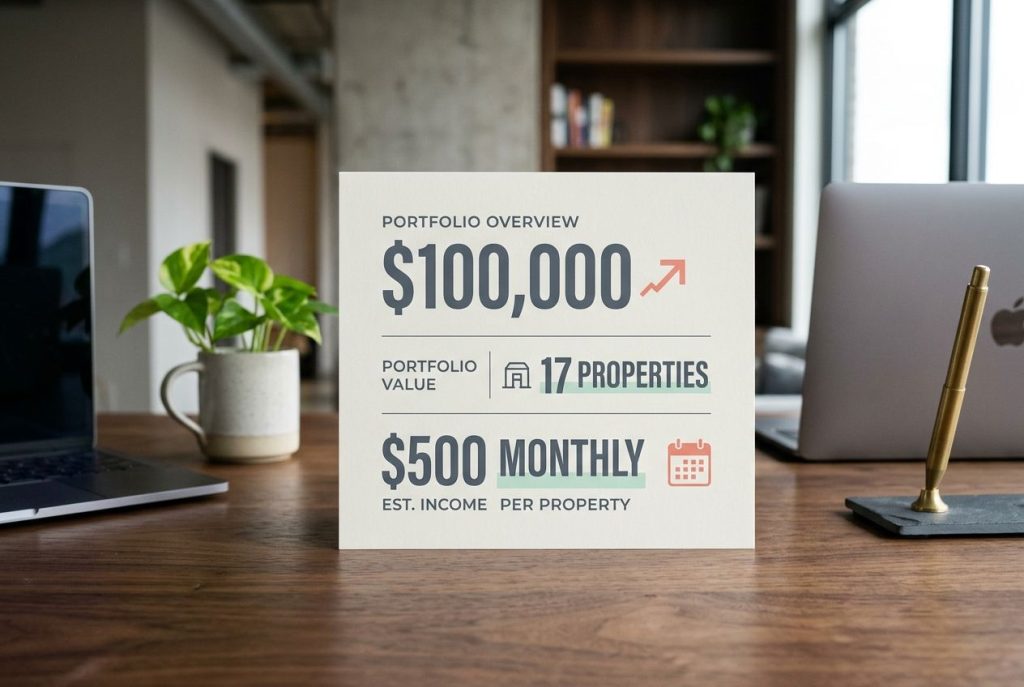
One clear fact is that a single-family home typically brings in about $500 each month after costs if you have a mortgage. That means you may need 17 or more rental properties to reach your goal for passive income.
This blog post explains how numbers like net cash flow, market conditions in places like Orlando or San Jose, and rent calculators shape your journey as a real estate investor. Read on to learn how smart real estate investing can help boost your investment portfolio faster than you imagine!
Key Takeaways
- To make $100,000 a year from rentals, you need at least 17 single-family homes that net $500–$600 in cash flow per month after costs if you have mortgages.
- Short-term rentals like Airbnb can earn more per unit—about $15,000–$30,000 yearly. With good markets, only 4 to 7 of these properties may suffice.
- Paid-off homes increase your monthly profit ($800–$1,200/unit) but require higher upfront costs (over $300,000 each). Mortgaged homes let you scale faster while introducing more risk and lower cash flow.
- Multi-family units or small apartment buildings offer efficiency. A duplex or fourplex can return $8,000–$12,000 yearly per building. Larger complexes may provide up to $25,000 each year.
- Tool use is important. Rental calculators help track true income by considering repairs (5–10% of rent), vacancies (5–8%), management fees (8–12%), taxes, and insurance. They show real numbers before you purchase.

Key Factors Determining the Number of Rental Properties Needed
Many elements determine the number of investment properties needed to reach a $100k goal. Cash-on-cash return, gross rental income, and expenses all matter. Choices in places such as Dallas or San Jose, along with the property type—like single-family homes or duplexes—change outcomes.
How Do You Evaluate Cash Flow Per Property?
Begin by subtracting all costs from your gross rental income. Costs include mortgage payments, property taxes, insurance, repairs, and vacancy losses. A single-family home or duplex in Dallas, Texas, might net $500 to $800 monthly if managed well.
When property management fees are added, cash flow may range from $300 to $600 per unit. Mike D’Arrigo of RealWealth states, “Each dollar left after paying the bills is true cash flow.”
Seek properties with high cash-on-cash returns. Self-managed rentals can offer between 8 percent and 15 percent annually. Use online rental property calculators or spreadsheets to get a clear view before purchase.
Small multi-family homes usually net $8,000 to $12,000 per year, while larger ones can reach up to $25,000 in profit.
What Role Do Location and Market Conditions Play?
Location matters. High-demand cities like San Jose, California, often deliver higher cash flow and fewer vacancies. The local real estate market impacts both property prices and rent increases.
Job growth and new companies boost rental demand quickly. Some areas offer creative strategies such as house hacking or renting single offices within commercial spaces. Local rules also influence outcomes. Property taxes, landlord laws, zoning, and licensing vary widely.
Multi-family buildings near busy hubs might fill faster but face stricter rules compared to suburban single homes. In slow growth cycles like what Mike D’Arrigo refers to as “The Great Greydale,” rents might remain almost steady while vacancies extend.
Investors use tools like the capitalization rate calculator to gauge risk and reward using data from sources such as ZipRecruiter or DSCR loan offers.
How Does Financing and Mortgage Affect Your Investments?
Mortgages let you use leverage to purchase more rental properties with less cash. Most lenders require 15 to 25 percent down for homes and 20 to 35 percent for commercial sites.
For a $300,000 house, you may need $50,000 to $80,000 up front. Some investors use FHA loans or house hacking with as little as 3.5 percent down.
Loan payments reduce monthly cash flow, yet building equity over time is a benefit. Higher interest rates or strict loan rules can reduce profits after costs.
What Are the Typical Operating and Maintenance Costs?
Operating and maintenance costs can quickly strain a budget. Keeping an eye on these figures is crucial when calculating rental property cash flow.

| Expense Type | Description | Typical Cost or Range | Notes |
|---|---|---|---|
| Repairs | Fixing plumbing, electrical, minor damages | Varies, often 5-10% of gross rent | Major repairs spike costs, such as roof or HVAC replacement |
| Vacancy | Time the property is empty, no rent collected | Plan for 5-8% of annual rent | Changes in market demand affect vacancy rate. Use conservative estimates. |
| Property Management Fees | Fee for professional management services | 8-12% of collected rent | Self-management lowers this cost but requires more time |
| Maintenance Reserves | Funds set aside for future fixes | 5-10% of gross rent | Avoid financial surprises with reserved funds |
| Insurance | Protection for property and liability | $500-$2,000+ per year, based on property type and location | Required by lenders; costs may rise in storm-prone areas |
| Property Taxes | Local government taxes on real estate | Varies widely; check local rates | Annual cost and sometimes higher in some cities |
| Major Repairs/CapEx | Roof, HVAC, appliances, structural items | Can reach thousands per event | Commercial units may need higher reserves |
Property management tools such as RentRedi and AppFolio help keep track of these expenses. Multi-family units may have lower costs per door, while single-family homes might face more frequent maintenance issues. Budgeting properly for operating expenses gives you a clear view of actual cash flow.
Calculating Your Goal for Rental Properties
Determining how many homes, apartments, or commercial properties you need requires simple math tools like net income formulas and rental calculators. Read on to see how these figures can shape your real estate journey.
How Do You Apply the Net Operating Income (NOI) Formula?
The Net Operating Income (NOI) formula shows if a rental property can generate profit. It is essential knowledge for real estate investors, lenders, and anyone using the BRRRR strategy (buy, rehab, rent, refinance, repeat).
- Start with your gross rental income. This is the total rent collected from tenants each year.
- Subtract operating expenses. Do not include mortgage payments.
- Operating expenses cover items such as repairs, property management, insurance, and taxes.
- The formula is: NOI = Gross Rental Income minus Operating Expenses.
- Lenders use NOI to decide if a commercial real estate loan is approved since it shows cash generated before debt costs.
- Commercial property values often use NOI along with the capitalization rate; higher NOI means higher value.
- NOI allows you to compare properties because it excludes financing costs. This highlights true cash flow.
- Investors in 2024 pay close attention to strong NOI numbers when choosing apartments or small business buildings for steady returns.
- Online tools and rental calculators use this formula to project future cash flow under strategies like BRRRR or other growth plans.
How Do You Calculate Your Monthly Cash Flow Needs?
It is important to know the money you want to earn each month from your rental properties. Start with an annual income goal, for example $100,000 from rentals. Divide that goal by 12 to get roughly $8,333 each month.
Subtract all costs from the expected rent. These include mortgage payments, property tax, insurance, repairs, and maintenance. Reserve about 5–10% of rental income to cover unexpected expenses such as vacancies or major repairs.
Use realistic numbers. Rental calculators assist in adding up rent and subtracting regular expenses to show the remaining amount. Check if your cash flow after all costs meets your target of $8,333 per month.
If average single-family homes earn about $500 per month after costs, then owning at least 17 such houses is necessary.
Understanding Rental Income Targets
Rental income goals such as making $100,000 a year depend on the net cash from each property. The cash flow per property is shaped by rent, operating costs, and mortgage payments.
For example, if one home brings in $500 a month after all costs, you may need at least 17 homes to reach the annual goal. Changing the expense estimates or financing terms can alter this number, which shows the importance of careful cash flow analysis [16].
Optimizing Financing Strategies and Expense Assumptions
Financing terms play a key role in the cash flow of your rental properties. The interest rate, loan-to-value ratio, and loan period all affect how much money is used for debt service. These factors are vital when aiming for an annual income target such as $100,000 [16].
Expense assumptions matter as well. If actual costs exceed estimates, the net income will drop, and more properties may be required to reach your target.
How Can Rental Property Calculators Help You?
Rental property calculators simplify the math. These tools use key facts such as purchase price, mortgage terms, rent collected, expenses, and vacancy rates. They show an estimated monthly cash flow and project your net operating income.
Numbers adjust in real time when rent or costs change. Calculators help compare several properties side by side. Many also factor in tax benefits by including depreciation to show accurate after-tax returns.
Investors at any level find calculators easy to use on websites like BiggerPockets or Zillow Rental Manager.
Comparing Paid-Off and Mortgaged Properties
A property without a loan typically yields higher monthly earnings because there are no mortgage payments, even though upfront costs are greater. Cash flow calculators like Stessa or BiggerPockets track income and expenses, showing you the actual money you receive each month.
What Income Can You Expect from Paid-Off Properties?
Paid-off rental homes usually provide stable cash flow and reduce risk. Consider these figures:
| Key Point | Summary | Example / Figure |
|---|---|---|
| Monthly Cash Flow | Rent minus operating costs becomes available income. | $800–$1,200 per unit, per month |
| Common Operating Expenses | Taxes, insurance, repairs, property management. | Usually 30%–40% of gross rent |
| Capital Requirement | More upfront cash, less debt risk later. | $300,000+ per property |
| Sensitivity to Interest Rates | Stable cash flow since there are no fluctuating loan payments. | Mortgage-free, so no jumps in payments |
| Risk Profile | Reduced foreclosure risk and more stability. | Owned outright |
| Return on Capital | Lower cash-on-cash returns due to tied-up cash. | Lower returns compared to leveraged investments |
| Portfolio Growth | Slower expansion with predictable income. | Fewer properties initially |
| Equity Access | Equity can be accessed if property values rise. | Option for cash-out refinance |
How Do You Manage Cash Flow with Mortgaged Properties?
Keep careful records of every dollar in and out. Most mortgaged single-family rentals yield $500 to $600 per month after covering the loan, taxes, insurance, and repairs.
Down payments are significant. For a $300,000 home, expect to pay 15 to 25 percent up front, which means $50,000 to $80,000. Variable-rate loans may affect your cash flow if interest rates rise. Budget extra cash reserves for vacancies or sudden costs to avoid missed payments.
Lenders check debt service coverage ratios to ensure that rents cover the mortgage with a margin. Leverage can speed up portfolio growth but adds risk if rents drop or expenses rise quickly.
Alternative Routes to Earn $100k from Real Estate
You have several choices, from vacation rentals to group real estate deals that pool funds with other investors. Use online property platforms and income calculators to see which option suits your investment goals best.
How Can Short-Term Rentals Generate Income?
Short-term rentals like Airbnb or Vrbo typically generate more cash per night than long-term leases. Owners can earn $15,000 to $30,000 each year from one property. In favorable markets with high demand, only 4 to 7 properties might be enough to reach an annual goal of $100,000.
These homes require similar startup funds as standard rentals. Expect income to vary with seasonality and extra work due to frequent guest turnover. Cities sometimes impose limits on short-term rentals; rules can change quickly and affect your plans.
Investors use tools like AirDNA or Mashvisor to monitor local trends and adjust prices for optimal results in vacation markets such as Orlando, Miami Beach, and Nashville.
What Are Real Estate Syndications and How to Invest?
Real estate syndications pool money from multiple investors. Sponsors or managers lead these groups to acquire large rental properties like apartment complexes. Investment amounts typically range from $25,000 to $100,000 per deal.
The JOBS Act of 2012 made these deals easier for accredited investors. Yearly cash flow generally falls between 6 percent and 10 percent, while total annualized returns may reach 12 percent to 18 percent.
You do not have day-to-day control over the property, but you share in passive income and some ownership equity. Deals usually last between three to seven years, during which funds remain locked in.
How Does the BRRRR Strategy Work?
Investors use the BRRRR strategy to expand their rental property portfolios quickly. This strategy involves buying distressed or underpriced homes, rehabbing them, renting them out, refinancing based on their improved value, and then using the funds to purchase more properties.
- Search for properties that need repairs.
- Purchase these properties at a low price using cash or short-term financing.
- Repair the house so it meets safety codes and attracts tenants.
- Rent out the property to generate steady income.
- Wait until rental income stabilizes, then have the property reappraised.
- Refinance using long-term mortgages and obtain cash if possible.
- Use the reclaimed cash for another property purchase, repeating the cycle.
- Cash flow will depend on rent received minus new mortgage payments after refinancing.
- Strong project management is crucial to avoid delays or cost overruns.
- Be aware of risks such as unexpected repair costs or lower-than-expected appraisal values.
- Rental property calculators and the NOI formula help check each deal’s viability before starting the cycle.
Examining Different Types of Rental Properties
Rental properties take many forms, including single-family homes, small apartment buildings, and commercial spaces. Each offers different risks and rewards. Reviewing these options helps match them to your plan and budget. Consider cash flow numbers carefully before making a decision.
Why Invest in Single-Family Homes?

Investing in single-family homes often yields steady cash flow for many investors. Each property may generate $500 to $800 per month after expenses, or about $4,000 to $6,000 annually. A typical down payment of 15% to 25% means you might need around $50,000 to $80,000 for a $300,000 home.
Simpler management is an advantage compared with multi-unit properties. Demand remains strong since many people prefer private homes with yards. Tax savings from depreciation and potential property value growth add to their appeal.
What Are the Benefits of Multi-Family Units?

Multi-family units offer higher income potential from one property. Rent is collected from several tenants instead of one. A duplex or four-unit building can yield $8,000 to $12,000 in annual cash flow.
Larger properties with 10 or more apartments might bring in $15,000 to $25,000 per building each year. Down payments for such buildings often range from 15% to 25%. With several units, vacancies impact less since remaining tenants continue to pay rent.
Shared expenses across units can lower operating costs.
Should You Consider Commercial Real Estate?
Commercial real estate often offers higher returns, with annual cash-on-cash returns from 8 percent to 15 percent. To purchase a $2 million property, you might need between $400,000 and $700,000 down.
Vacancies or poor management can quickly reduce income. Improving tenant income, however, may boost equity and support refinancing strategies. Many owners hire professional property managers to maintain daily operations in this higher-risk segment.
Strategies to Expand Your Rental Property Portfolio
You can increase your property holdings with smart planning and proper use of tools. Study effective techniques such as using rental calculators and consulting reliable real estate agents to reach higher income goals.
How Can Starting Early Help You Save?
Early investors enjoy distinct advantages. FHA loans or owner-occupied financing may require only 3.5% down. House hacking lets you live in part of your home while renting out the remainder to build savings and equity over time.
The longer you hold a property, the better your chance of gaining from rising values and gradual mortgage paydown. Reinvesting cash flow over the years funds additional purchases and speeds portfolio growth. Loan officers appreciate a record of early successes, which can lead to better rates.
How Do You Choose Profitable Properties?
Selecting the right rental property boosts cash flow and helps you achieve the $100k target faster. Base your decisions on solid facts, research, and proven tools. Use a rental property calculator to assess expected cash flow, expenses, and returns before you make an offer.
Focus on properties with a projected cash-on-cash return of 8% or more. Evaluate local market demand by studying vacancy rates and rent growth. Look at areas with strong tenant pools, such as near colleges, hospitals, or major employers.
Check for landlord-friendly laws, as seen in states like Florida, which help protect your rights. Identify properties where repairs or upgrades can boost rents or values. Avoid properties with high deferred maintenance so repair costs do not quickly erode profits.
Reviewing zoning rules helps ensure future rental options remain open. Choosing properties close to your residence can reduce management costs and allow rapid issue resolution.
What Are Refinancing and Tax Strategies You Can Use?
Smart refinancing and tax strategies can speed your progress toward earning $100k from rentals while preserving more cash. A brief overview of methods and tools includes:

| Strategy | Details | Key Entities and Tools | Example / Stat |
|---|---|---|---|
| Cash-Out Refinancing | Borrow against property appreciation to access equity for new investments while retaining ownership. | Banks, mortgage lenders, Zillow, rental property calculators | Refinance a property with $200,000 equity to pull out $100,000 for a down payment on another. |
| 1031 Exchange | Defer taxes on gains by selling and reinvesting in a similar property, preserving capital for growth. | IRS, real estate attorneys, 1031 qualified intermediaries | Sell a rental for $7 million, defer capital gains tax on $140,000 profit by reinvesting. |
| Depreciation | This paper expense lowers taxable income, which improves after-tax cash flow each year. | CPAs, IRS forms, depreciation schedule calculators | Annual depreciation deduction of $2,900 on a $100,000 share in a syndication reduces taxes. |
| Carry Forward Paper Losses | Offset future passive income or gains with unused depreciation losses. | Tax software, CPA, IRS Schedule E | Use current year paper losses to lower taxes on future rental profits. |
| Portfolio Growth with Refinancing | Increase portfolio size by pulling equity and reinvesting instead of selling to scale faster. | Banks, mortgage brokers, personal finance apps | Recycle equity from one house into the next property to repeat success. |
| Tax Benefits Apply to Direct Ownership | Direct owners receive depreciation and 1031 perks; REITs and wholesaling do not offer these benefits. | Real property management firms, IRS rules | Owning outright allows claiming of tax breaks, unlike investing in a REIT. |
Why a Property Management Company Is Crucial to Profitable Rentals
Scale your investments wisely. Hiring a property management company often proves beneficial when self-managing becomes too time-consuming. Fees typically range between 8 and 12 percent of rent. This expense may lower net cash flow but saves time and can improve occupancy rates; with increased occupancy and the ability to handle all your rental properties, it makes scaling up possible to truly grow your rental business.
Professionals handle advertising, tenant screening, lease enforcement, legal compliance, and emergency repairs. Owners managing large multi-family buildings or commercial spaces benefit from local experts who know rental laws and maintenance needs.
In the Orlando Fl area, you can count on our team at Guest Managers. With dynamic pricing that adjusts according to market demands, your pricing becomes highly competitive and attractive to tenants and guests. Contact us today and see your rental business scale up.
Conclusion
Reaching $100,000 a year in rental income depends on clear strategy and execution. Choosing the right location, understanding cash flow, and weighing the benefits of paid-off versus mortgaged homes form the core of your plan.
Simple tools like online calculators and concepts such as short-term rentals or syndications can simplify your approach. Books, podcasts, and expert discussions with local real estate agents help refine your methods.
Disclosure: The information provided here is based on publicly available data, verified external links, and expert input. The research process relied on reputable sources and industry best practices. This content is intended for informational purposes only and is not financial advice.